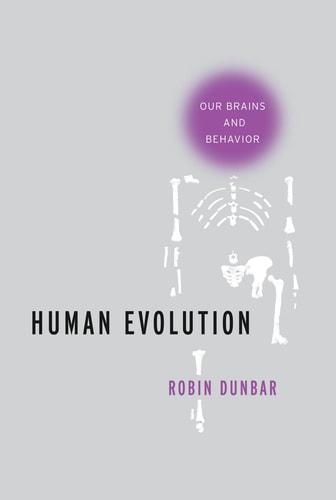
Human Evolution: Our Brains and Behavior
0
0
As an Amazon Associate and affiliate partner, Menrva Books earns from qualifying purchases. Learn more
Author Description
The story of human evolution has fascinated us like no other: we seem to have an insatiable curiosity about who we are and where we have come from. Yet studying the "stones and bones" skirts around what is perhaps the realest, and most relatable, story of human evolution - the social and cognitive changes that gave rise to modern humans.In Human Evolution: Our Brains and Behavior, Robin Dunbar appeals to the human aspects of every reader, as subjects of mating, friendship, and community are discussed from an evolutionary psychology perspective. With a table of contents ranging from prehistoric times to modern days, Human Evolution focuses on an aspect of evolution that has typically been overshadowed by the archaeological record: the biological, neurological, and genetic changes that occurred with each "transition" in the evolutionary narrative. Dunbar's interdisciplinary approach - inspired by his background as both an anthropologist and accomplished psychologist - brings the reader into all aspects of the evolutionary process, which he describes as the "jigsaw puzzle" of evolution that he and the reader will help solve. In doing so, the book carefully maps out each stage of the evolutionary process, from anatomical changes such as bipedalism and increase in brain size, to cognitive and behavioral changes, such as the ability to cook, laugh, and use language to form communities through religion and story-telling. Most importantly and interestingly, Dunbar hypothesizes the order in which these evolutionary changes occurred-conclusions that are reached with the "time budget model" theory that Dunbar himself coined. As definitive as the "stones and bones" are for the hard dates of archaeological evidence, this book explores far more complex psychological questions that require a degree of intellectual speculation: What does it really mean to be human (as opposed to being an ape), and how did we come to be that way?
Menrva's Summary
THE THESIS
This book investigates the core question of how cognitive and social adaptations, rather than mere physical artifacts, defined the trajectory of human evolution. Robin Dunbar, an anthropologist and psychologist, utilizes his proprietary 'time budget model' to reconstruct the sequence of behavioral and neurological transitions that distinguish humans from other primates. By synthesizing data from archaeology, genetics, and behavioral science, he constructs a framework that prioritizes the development of social complexity over traditional anatomical focus.
THE SCOPE MAP
What You Will Find
- Analysis of the 'time budget model' as a tool for evolutionary sequencing
- Examination of cognitive milestones including language, humor, and religious formation
- Discussion of biological transitions such as bipedalism and encephalization
- Interdisciplinary synthesis of anthropology and psychology
Scope Limits
- Does not provide a comprehensive catalog of the entire archaeological fossil record
- Does not focus on non-primate evolutionary biology
THE AUTHORITY PERSPECTIVE
Experts recognize this work as a significant contribution to evolutionary psychology, particularly for its focus on social brain theory. Readers frequently note the accessibility of the prose despite the academic rigor of the underlying evolutionary models.
Page Count:
432
Publication Date:
2016-11-28
Publisher:
Oxford University Press
ISBN-10:
0190616784
ISBN-13:
9780190616786
Science
Anthropology
Evolutionary Psychology
Biology
Community Tags
Similar Books