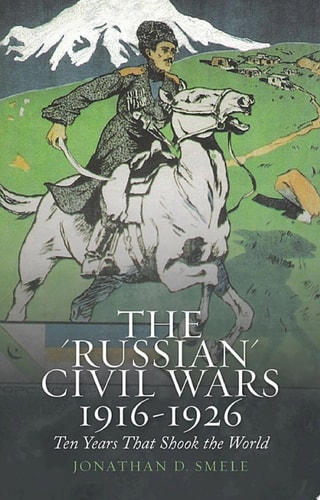
The 'Russian' Civil Wars, 1916-1926: Ten Years That Shook the World
0
0
As an Amazon Associate and affiliate partner, Menrva Books earns from qualifying purchases. Learn more
Author Description
This volume offers a comprehensive and original analysis and reconceptualisation of the compendium of struggles that wracked the collapsing Tsarist empire and the emergent USSR, profoundly affecting the history of the twentieth century. Indeed, the reverberations of those decade-long wars echo to the present day - not despite, but because of the collapse of the Soviet Union, which re-opened many old wounds, from the Baltic to the Caucasus. Contemporary memorialising and 'de-memorialising' of these wars, therefore form part of the book's focus, but at its heart lie the struggles between various Russian political and military forces which sought to inherit and preserve, or even expand, the territory of the tsars, overlain with examinations of the attempts of many non-Russian national and religious groups to divide the former empire. The reasons why some of the latter were successful (Poland and Finland, for example), while others (Ukraine, Georgia and the Muslim Basmachi) were not, are as much the author's concern as are explanations as to why the chief victors of the 'Russian' Civil Wars were the Bolsheviks. Tellingly, the work begins and ends with battles in Central Asia - a theatre of the 'Russian' Civil Wars that was closer to Mumbai than it was to Moscow.
Menrva's Summary
THE THESIS
This volume investigates the complex series of conflicts that defined the collapse of the Tsarist empire and the emergence of the Soviet Union between 1916 and 1926. Jonathan Smele, a specialist in Russian history, utilizes a broad range of archival and secondary sources to re-evaluate the multifaceted nature of these wars. He argues that the conflict was not a singular event but a collection of overlapping struggles involving political, military, national, and religious factions across the former empire. The work seeks to explain why the Bolsheviks emerged as the ultimate victors while analyzing the varying success of independence movements in regions like Finland, Poland, and the Caucasus.
THE SCOPE MAP
What You Will Find
- A comprehensive analysis of the decade-long conflict spanning from 1916 to 1926.
- Comparative studies of successful and failed national independence movements within the former empire.
- An examination of the Central Asian theater as a critical, often overlooked, front of the war.
- Analysis of contemporary memorialization and the political legacy of these conflicts.
Scope Limits
- The text focuses primarily on the political and military power struggles rather than a detailed social history of the civilian population.
- It does not provide an exhaustive military history of every individual engagement, prioritizing strategic and political outcomes.
THE AUTHORITY PERSPECTIVE
Experts recognize this work as a significant contribution to the historiography of the Russian Civil War, particularly for its inclusion of peripheral theaters like Central Asia. Readers frequently note the academic density of the prose, which serves as a rigorous resource for students and scholars of twentieth-century history.
Page Count:
423
Publication Date:
2016-01-01
Publisher:
Oxford University Press
ISBN-10:
0190613491
ISBN-13:
9780190613495
History
Russian History
Political History
Military History
Civil War
European History
20th Century
Community Tags
Similar Books