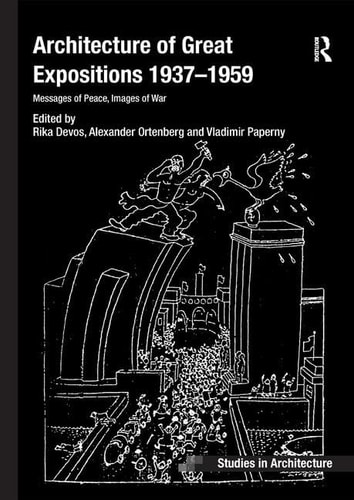
Architecture of Great Expositions 1937-1959: Messages of Peace, Images of War
0
0
As an Amazon Associate and affiliate partner, Menrva Books earns from qualifying purchases. Learn more
Author Description
This book investigates architecture as a form of diplomacy in the context of the Second World War at six major European international and national expositions that took place between 1937 and 1959. The volume gives a fascinating account of architecture assuming the role of the carrier of war-related messages, some of them camouflaged while others quite frank. The famous standoffs between the Stalinist Russia and the Nazi Germany in Paris 1937, or the juxtaposition of the USSR and USA pavilions in Brussels 1958, are examples of very explicit shows of force. The book also discusses some less known - and more subtle - messages, revealed through an examination of several additional pavilions in both Paris and Brussels; of a series of expositions in Moscow; of the Universal Exhibition in Rome that was planned to open in 1942; and of London's South Bank Exposition of 1951: all of them related, in one way or another, to either an anticipation of the global war or to its horrific aftermaths. A brief discussion of three pre-World War II American expositions that are reviewed in the Epilogue supports this point. It indicates a significant difference in the attitude of American exposition commissioners, who were less attuned to the looming war than their European counterparts. The book provides a novel assessment of modern architecture's involvement with national representation. Whether in the service of Fascist Italy or of Imperial Japan, of Republican Spain or of the post-war Franquista regime, of the French Popular Front or of socialist Yugoslavia, of the arising FRG or of capitalist USA, of Stalinist Russia or of post-colonial Britain, exposition architecture during the period in question was driven by a deep faith in its ability to represent ideology. The book argues that this widespread confidence in architecture's ability to act as a propaganda tool was one of the reasons why Modernist architecture lent itself to the service of such different masters.
Menrva's Summary
THE THESIS
This book investigates architecture's role as a tool of diplomacy and propaganda during the tumultuous period surrounding World War II. It examines six major European international and national expositions held between 1937 and 1959, detailing how architectural designs conveyed messages of peace or war, sometimes overtly and sometimes subtly. The analysis extends to lesser-known pavilions in Paris and Brussels, expositions in Moscow, a planned exposition in Rome, and London's South Bank Exposition, all linked to the war's anticipation or aftermath. The epilogue contrasts these with pre-war American expositions, highlighting a different approach by American commissioners.
THE SCOPE MAP
- Analysis of architectural diplomacy at major European expositions from 1937 to 1959.
- Examination of explicit shows of force, such as the Stalinist Russia and Nazi Germany stands in Paris 1937.
- Discussion of subtle messages conveyed through pavilion designs in Paris, Brussels, and Moscow.
- Exploration of the planned 1942 Universal Exhibition in Rome and London's 1951 South Bank Exposition.
- Assessment of Modernist architecture's involvement with national representation across various ideologies (Fascist Italy, Imperial Japan, Republican Spain, post-war Franquista regime, French Popular Front, socialist Yugoslavia, FRG, USA, Stalinist Russia, post-colonial Britain).
- Argument for architecture's function as a propaganda tool serving diverse political masters.
- Comparison with pre-World War II American expositions and their commissioners' attitudes.
THE AUTHORITY PERSPECTIVE
The book offers a novel assessment of modern architecture's engagement with national representation during a critical historical period. It posits that architecture's perceived ability to convey ideology and act as a propaganda tool was a key factor in Modernist styles serving a wide array of political regimes. The detailed examination of specific expositions and pavilions provides concrete examples to support its central thesis.
Page Count:
256
Publication Date:
2017-01-01
Publisher:
Taylor & Francis Group
ISBN-10:
1138573353
ISBN-13:
9781138573352
Politics
Non-Fiction
Architecture
History
Community Tags
Similar Books















Reader Comments
Share Your Thoughts
No comments yet. Be the first to share your thoughts!