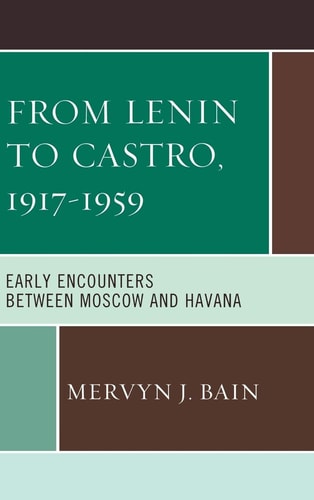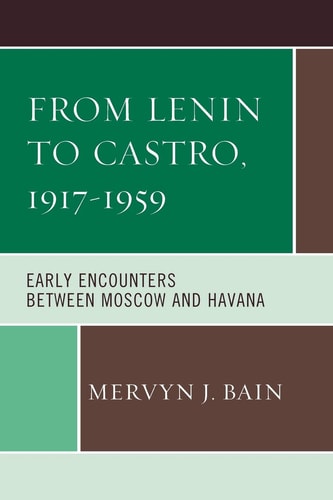
From Lenin to Castro, 1917–1959: Early Encounters Between Moscow and Havana
0
0
As an Amazon Associate and affiliate partner, Menrva Books earns from qualifying purchases. Learn more
Author Description
This book addresses the relationship between Moscow and Havana in the period between the Russian and Cuban Revolutions, i.e. from November 1917 to January 1959. It analyzes the reasons why in this era before the Cuban Revolution, which is traditionally thought to have ignited Moscow’s interest in the Caribbean island, a relationship existed between the two countries at a variety of different levels. In order to do this, both the attention that the Third International, or Comintern, gave to Cuba, as well as Moscow’s formal state-to-state relations with Havana, are examined. In addition, United States policy towards both socialism and the Soviet Union are analyzed, due to the role that Washington played in Cuba prior to the Cuban Revolution. Following this, an examination of the events, process and dynamics that characterized the nature of the relationship between Moscow and Havana from 1917 to 1959 will be conducted. A number of conclusions will be given, but the primary one is that prior to January 1959, the Kremlin took considerable interest in Cuba and did not suffer from “geographical fatalism,” as has traditionally been thought. This is significant in itself, but also in light of the relationship that rapidly developed between Moscow and Havana in the aftermath of the Cuban Revolution, as a number of factors that were important in the pre-1959 relationship would also be significant after 1959. Furthermore, this analysis is also important for the contemporary bilateral relationship between Russia and Cuba, as both governments have made increasing reference to the multifaceted relationship that existed prior to 1959.
Menrva's Summary
THE THESIS
This book investigates the nature and extent of the relationship between Moscow and Havana from the Bolshevik Revolution in 1917 up to the Cuban Revolution in 1959. Mervyn J. Bain, drawing on extensive archival research and analysis of both formal state-to-state relations and the activities of the Comintern, argues against the traditional view that Soviet interest in Cuba began only after 1959. The book posits that a significant, multifaceted relationship existed for decades prior, driven by factors beyond immediate geopolitical advantage, and that this pre-revolutionary engagement laid groundwork for future ties.
THE SCOPE MAP
- Analysis of the Third International's (Comintern) engagement with Cuba.
- Examination of formal state-to-state relations between the Soviet Union and Havana.
- Assessment of United States policy towards socialism and the Soviet Union in relation to Cuba.
- Detailed chronological account of events, processes, and dynamics shaping the Moscow-Havana relationship from 1917 to 1959.
- Argument that the Kremlin maintained considerable interest in Cuba prior to 1959, challenging the notion of "geographical fatalism."
- Exploration of factors in the pre-1959 relationship that remained significant after the Cuban Revolution.
THE AUTHORITY PERSPECTIVE
This historical analysis is likely to be of interest to scholars of Soviet foreign policy, Cuban history, and the Cold War. Its detailed examination of previously under-appreciated diplomatic and ideological connections between Moscow and Havana before 1959 offers a nuanced perspective on the origins of their post-revolutionary alliance. The book's argument challenges conventional historiography by highlighting sustained Soviet interest in the Caribbean island decades before Fidel Castro's rise to power.
Page Count:
170
Publication Date:
2015-03-25
Publisher:
Bloomsbury Academic
ISBN-10:
149851541X
ISBN-13:
9781498515412
History
Non-Fiction
International relations