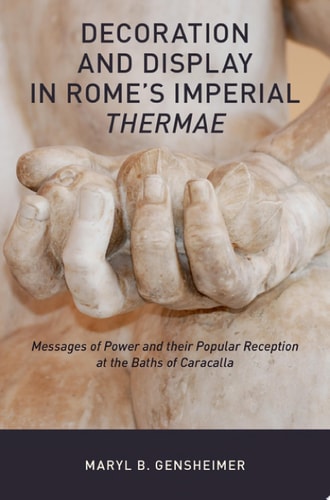
Decoration and Display in Rome's Imperial Thermae
0
0
As an Amazon Associate and affiliate partner, Menrva Books earns from qualifying purchases. Learn more
Author Description
Across The Roman Empire, Ubiquitous Archaeological, Art Historical, And Literary Evidence Attests To The Significance Of Bathing For Romans' Routines And Relationships. Public Baths Were Popularly Viewed As Necessities Of Daily Life And Important Social Venues. Given The Importance Of Bathing To The Roman Style Of Living, By Endowing Eight Magnificent Baths (the So-called Imperial Thermae) In The City Of Rome Between 25 Bce - 315 Ce, Imperial Patrons Greatly Enhanced Their Popular And Political Stature. Decoration And Display In Rome's Imperial Thermae Presents A Detailed Analysis Of The Extensive Decoration Of The Best Preserved Of These Bathing Complexes, The Baths Of Caracalla (inaugurated 216 Ce). Maryl B. Gensheimer Takes An Interdisciplinary Approach To Existing Archaeological Data, Textual And Visual Sources, And Anthropological Theories In Order To Generate A New Understanding Of The Visual Experience Of The Baths Of Caracalla And Show How The Decoration Played A Critical Role In Advancing Imperial Agendas. This Reassessment Of One Of The Most Ambitious And Sophisticated Examples Of Large-scale Architectural Patronage In Classical Antiquity Examines The Specific Mechanisms Through Which An Imperial Patron Could Use Architectural Decoration To Emphasize His Own Unique Sociopolitical Position Relative To The Thousands Of People Who Enjoyed His Benefaction. The Case Studies Addressed Herein--ranging From Architectural To Freestanding Sculpture And Mosaic--demonstrate That Sponsoring Monumental Baths Was Hardly An Act Of Altruism. Rather, Even While They Provided Recreation For Elite And Sub-altern Romans Alike, Such Buildings Were Concerned Primarily With Dynastic Legitimacy And Imperial Largess. Decorative Programs Articulated These Themes By Consistently Drawing Analogies Between The Subjects Of The Decoration And The Emperor Who Had Paid For It. The Unified Decorative Program--and The Messages Of Imperial Power Therein--adroitly Honored The Emperor And Conso
Menrva's Summary
THE THESIS
This book investigates how the decorative programs within Rome's Imperial Thermae served as sophisticated instruments of political propaganda and dynastic legitimation for the ruling emperors. Maryl B. Gensheimer, an expert in Roman art and architecture, synthesizes archaeological evidence with anthropological theory to analyze the Baths of Caracalla. She argues that the lavish ornamentation of these public spaces was not merely aesthetic, but a calculated mechanism to reinforce the emperor's status and authority among the diverse Roman populace.
THE SCOPE MAP
What You Will Find
- Analysis of the Baths of Caracalla as a primary case study for imperial patronage.
- Examination of architectural elements, freestanding sculpture, and mosaic programs.
- Integration of textual, visual, and archaeological data sets.
Scope Limits
- The study focuses primarily on the Baths of Caracalla rather than an exhaustive survey of all eight Imperial Thermae.
- The analysis is limited to the period between 25 BCE and 315 CE.
THE AUTHORITY PERSPECTIVE
Scholars recognize this work as a rigorous interdisciplinary study that successfully bridges the gap between architectural history and political sociology. Readers frequently note the academic density of the prose, which provides a comprehensive framework for understanding the intersection of Roman public life and imperial ideology.
Page Count:
368
Publication Date:
2018-01-01
Publisher:
Oxford University Press
ISBN-10:
019061479X
ISBN-13:
9780190614799
History
Architecture
Roman Empire
Art History
Archaeology
Community Tags
Similar Books