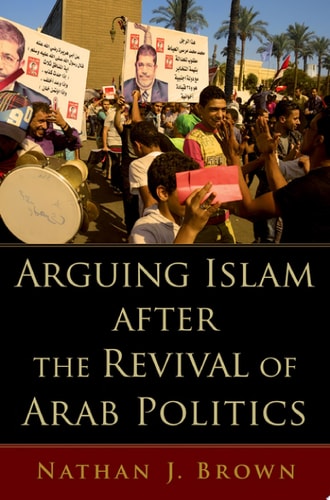
Arguing Islam after the Revival of Arab Politics
0
0
As an Amazon Associate and affiliate partner, Menrva Books earns from qualifying purchases. Learn more
Author Description
For much of its modern history, a combination of deep nervousness and profound lack of interest seemed to inhibit or even prevent regular political conversations in the Arab World. Public spaces were devoid of political discussions: public squares in major cities showed no signs of assemblies for political purposes. If one picked up a newspaper, one was more likely to read about the comings and goings of officials rather than any sort of comprehensive political coverage.In the wake of the Arab Spring, newer media and older forms (such as the daily newspaper) have gradually made it easier for Middle East countries to participate in public debates from a variety of ideological perspectives. The state retreat from social welfare commitments have opened opportunities for a host of new informal groups and organizations to operate in areas previously dominated by officially-controlled bodies. These trends have obviously been noticed by social scientists, but scholars who focus on the large-scale political changes tend to edge into a celebratory tone: the changes are seen as potentially democratizing.Arguing Islam after the Revival of Arab Politics presents an understanding the "revived" forms of Arab politics as they really are, and does not speculate about the democratic future these changes could signal. In particular, this book examines various sites of Arab public life to explore how politics operates. Four kinds of public spheres are brought into focus: small group discussions that straddle the public/private divide (such as diwaniyyas in Kuwait or piety groups in Egypt), public spaces of assembly (such as public squares and mosques), media (both new and old), and parliaments (an institution etymologically founded in philosophizing and pontificating rather than legislating). Further, the author gives due attention to the ways in which these spheres interact to explore how these gradations, affirmations, and subversions of hierarchy, status, and power make up the curr
Menrva's Summary
THE THESIS
This book investigates how the revival of Arab politics has transformed public discourse and the role of Islam within various spheres of social and institutional life. Nathan J. Brown, a professor of political science and international affairs, utilizes his extensive expertise in Middle Eastern legal and political systems to challenge optimistic narratives regarding democratization. He argues that the current political landscape is defined by complex, informal power dynamics rather than a linear progression toward Western-style democratic governance.
THE SCOPE MAP
What You Will Find
- Analysis of four distinct public spheres: small group discussions, public assembly spaces, media outlets, and parliamentary institutions.
- Examination of the intersection between informal social organizations and state-controlled bodies.
- Case studies focusing on specific cultural practices like Kuwaiti diwaniyyas and Egyptian piety groups.
Scope Limits
- The text does not provide a predictive model for the future of democratic development in the region.
- It avoids broad generalizations about the Arab world, focusing instead on specific sites of political interaction.
THE AUTHORITY PERSPECTIVE
Scholars and regional analysts frequently cite this work as a necessary corrective to overly idealistic interpretations of post-Arab Spring political shifts. Readers note the academic rigor of the prose, which provides a grounded, realistic assessment of how power and status are negotiated in contemporary Arab societies.
Page Count:
296
Publication Date:
2016-11-17
Publisher:
Oxford University Press
ISBN-10:
0190619422
ISBN-13:
9780190619428
Islam
Sociology
Arab Countries
Middle East
Islam And Politics
Public Policy
Community Tags
Similar Books