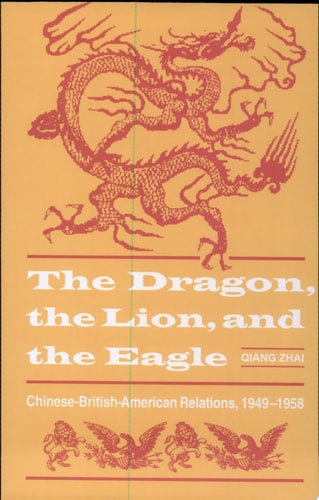
The Dragon, the Lion & the Eagle: Chinese-British-American Relations, 1949-1958
0
0
As an Amazon Associate and affiliate partner, Menrva Books earns from qualifying purchases. Learn more
Author Description
The establishment of the People's Republic of China (PRC) in 1949 and the subsequent conclusion of the Sino-Soviet Alliance Treaty destroyed the old balance of power in East Asia and introduced new forces into the international system. These developments had important implications for Great Britain and the United States, both of which possessed significant interests in the region. Drawing on previously classified British and American documents and private papers, Qiang Zhai compares the respective policies toward the recognition of China and that country's representation in the United Nations; China's entry into the Korean War; the Geneva Conference of 1954; the Quemoy-Matsu crises of 1954-55 and 1958; and Chinese threats to Taiwan and Tibet. He carefully analyzes the objective of dividing the Sino-Soviet alliance as a goal of Anglo-American policies and uses recently available Chinese Communist materials - including inner-party documents, diaries, memoirs, and biographies by and about former Chinese leaders, generals, and diplomats - to reconstruct Chinese foreign policy initiatives and responses to Western challenges. With its unique international and comparative dimensions, this study allows the first clear view of early Cold War history from the Chinese as well as Western perspectives. Washington and London differed widely in their assessments of Beijing's intentions and capabilities, as reflected in their respective policies toward recognition and containment of China. Zhai examines the mutual influences and constraints - distinct strategic concerns, divergences in political structures, public opinion, interest groups, and diplomatic traditions, as well as the perceptions andidiosyncrasies of the top policymakers - that affected Anglo-American relations and shows how consideration of each other's reactions further complicated their policy decisions. This study in international history and comparative analysis avoids the tunnel vision so common in explorations o
Menrva's Summary
THE THESIS
The establishment of the People's Republic of China in 1949 fundamentally altered the geopolitical landscape of East Asia, presenting significant challenges and opportunities for Great Britain and the United States. Drawing on declassified British and American documents, as well as newly available Chinese Communist materials, Qiang Zhai meticulously compares the foreign policies of these three nations concerning China's recognition, UN representation, the Korean War, the Geneva Conference, and various crises in the Taiwan Strait and Tibet. The study critically examines the Anglo-American strategy to divide the Sino-Soviet alliance and reconstructs Chinese foreign policy initiatives from a Chinese perspective, offering a unique comparative analysis of early Cold War dynamics.
THE SCOPE MAP
- Analysis of British and American policies toward the recognition of the People's Republic of China (PRC).
- Examination of China's representation in the United Nations.
- Detailed account of China's entry into the Korean War and its implications.
- In-depth look at the Geneva Conference of 1954.
- Coverage of the Quemoy-Matsu crises of 1954-55 and 1958.
- Discussion of Chinese threats to Taiwan and Tibet.
- Exploration of the objective to divide the Sino-Soviet alliance as a goal of Anglo-American policies.
- Reconstruction of Chinese foreign policy initiatives using newly available Chinese Communist materials.
THE AUTHORITY PERSPECTIVE
This study is regarded as a significant contribution to understanding early Cold War history from a comparative, international perspective. By integrating declassified Western documents with recently accessible Chinese Communist materials, the book offers a nuanced view of the distinct strategic concerns, political structures, and policy decisions that shaped Anglo-American relations and China's foreign policy. The analysis highlights the divergences in Washington and London's assessments of Beijing's intentions and capabilities, providing a clear view of the period's complexities. The work is noted for its unique international and comparative dimensions, allowing for a comprehensive understanding of the era.
Page Count:
284
Publication Date:
1994-01-01
Publisher:
Kent State University Press
ISBN-10:
0873384903
ISBN-13:
9780873384902
History
Non-Fiction
American History
British History
Chinese History
International relations
Community Tags
Similar Books














