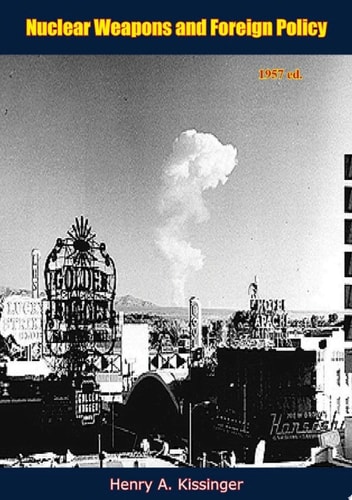
Nuclear Weapons and Foreign Policy
0
0
As an Amazon Associate and affiliate partner, Menrva Books earns from qualifying purchases. Learn more
Author Description
Now that there exist weapons capable of destroying humanity, our nation’s survival depends on our ability to find answers to two questions: What challenges should be resisted by force? How can they be resisted without brining disaster to our society? We must find a strategy which can support our diplomacy without being forced to risk our national substance on every issue. Otherwise we will increasingly face the grim alternative of total annihilation or total surrender. This book shows how our military strength can support our political objectives without excessive risk of all-out war. It discusses the diplomacy and the strategy necessary to deter aggression and to defeat it should it come. It makes clear that we require weapons as varied as the dangers confronting us. War can be avoided only by being ready for it. Nuclear Weapons and Foreign Policy, though entirely Dr. Kissinger’s own book, grew out of his work over a period of eighteen months with a group of experts organized by the Council on Foreign Relations and led by Mr. Gordon Dean, former Chairman of the Atomic Energy Commission. It deals primarily with the revolution produced by the development of nuclear weapons, and the effect which this revolution should have on our military strategy and foreign policy. Dr. Kissinger indicates that in all significant wars of the future, nuclear weapons are likely to be employed, but he shows that if proper doctrine is followed, the consequences need not be disastrous to our survival, as is often supposed. He then examines the implications of his new strategy for our relations with our allies and with the uncommitted countries of the world. And he analyzes the nature of the Soviet challenge in terms of ideology, diplomacy, and military policy. This book is of vital importance and certain to inspire serious thought.
Menrva's Summary
THE THESIS
This book investigates how nations can effectively employ nuclear weapons to support foreign policy objectives without risking global annihilation. Henry Kissinger, drawing on his work with a Council on Foreign Relations group, examines the profound impact of nuclear technology on military strategy and international relations. He argues for a nuanced approach that differentiates between types of aggression and the appropriate force required, suggesting that varied weaponry is essential to meet diverse threats. The book explores the doctrines necessary to deter and, if needed, defeat aggression, while also considering the implications for alliances and uncommitted nations in the context of the Soviet challenge.
THE SCOPE MAP
- Analysis of the strategic revolution brought about by nuclear weapons.
- Examination of how military strength can support political objectives without excessive risk.
- Discussion of the types of challenges that should be met with force.
- Exploration of strategies to resist aggression without causing societal disaster.
- Implications of nuclear strategy for relations with allies and uncommitted countries.
- Analysis of the Soviet challenge in terms of ideology, diplomacy, and military policy.
- The necessity of varied weaponry to counter diverse global dangers.
THE AUTHORITY PERSPECTIVE
Henry Kissinger's "Nuclear Weapons and Foreign Policy" is recognized as a seminal work that profoundly influenced strategic thinking during the Cold War. Its examination of deterrence and the potential use of nuclear weapons in limited conflicts offered a counterpoint to the prevailing doctrine of massive retaliation. The book's rigorous analysis of the complex interplay between nuclear capabilities and foreign policy objectives has been a subject of extensive academic and policy discussion for decades. It remains a critical text for understanding the evolution of nuclear strategy and its impact on international relations.
Page Count:
358
Publication Date:
2018-12-02
Publisher:
Pickle Partners Publishing
ISBN-10:
1789127572
ISBN-13:
9781789127577
History
Non-Fiction
Politics
International relations
Nuclear weapons
Foreign Policy
Cold War
Military Strategy
Community Tags
Similar Books