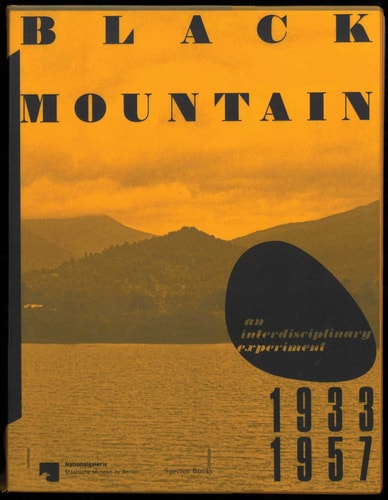
Black Mountain: An Interdisciplinary Experiment, 1933-1957
0
0
As an Amazon Associate and affiliate partner, Menrva Books earns from qualifying purchases. Learn more
Author Description
The interdisciplinary and experimental educational ideas espoused by Black Mountain College (BMC), which was founded in North Carolina in 1933, made it one of the most innovative schools, after the Bauhaus, of the first half of the 20th century. Visual arts, economics, physics, dance, architecture and music were all taught here on an equal footing, and teachers and students lived together in a democratically organized community. The first director of the school was Josef Albers, and icons such as John Cage, Walter Gropius and Buckminster Fuller were among the many luminaries invited to teach. In consequence, BMC witnessed the development of a cutting-edge range of avant-garde concepts and ideas that still influence the art world today. This richly illustrated book appears in conjunction with the Black Mountain exhibition. It is the first comprehensive publication on BMC in the German-speaking world and traces the key moments in the history of this legendary school.
Menrva's Summary
THE THESIS
Black Mountain College represented a radical experiment in interdisciplinary education and communal living that profoundly influenced 20th-century art and thought. Founded in North Carolina in 1933, the college treated visual arts, economics, physics, dance, architecture, and music as equal disciplines, fostering a unique environment where teachers and students lived together in a democratically organized community. Led initially by Josef Albers and featuring luminaries like John Cage, Walter Gropius, and Buckminster Fuller, BMC became a crucible for avant-garde concepts. This publication explores the key moments in the history of this legendary institution, which continues to impact the art world today.
THE SCOPE MAP
- The interdisciplinary and experimental educational ideas espoused by Black Mountain College.
- The equal footing given to visual arts, economics, physics, dance, architecture, and music.
- The democratic community structure involving teachers and students living together.
- The influence of key figures such as Josef Albers, John Cage, Walter Gropius, and Buckminster Fuller.
- The development of cutting-edge avant-garde concepts and ideas.
- The history of the school from its founding in 1933 to 1957.
- Richly illustrated content appearing in conjunction with a Black Mountain exhibition.
THE AUTHORITY PERSPECTIVE
This publication serves as the first comprehensive overview of Black Mountain College in the German-speaking world, appearing alongside a dedicated exhibition. The book traces the key historical moments of the college, highlighting its role as one of the most innovative schools of the first half of the 20th century, second only to the Bauhaus. Its focus on interdisciplinary education and avant-garde concepts is presented as having a lasting influence on the contemporary art world. The detailed exploration of its history and pedagogical approach positions it as a significant resource for understanding this influential institution.
Page Count:
463
Publication Date:
2015-01-01
Publisher:
Nationalgalerie, Staatliche Museen zu Berlin
ISBN-10:
3959050259
ISBN-13:
9783959050258
Art
History
Non-Fiction
Art History
Cultural History
Avant-garde
Community Tags
Similar Books














