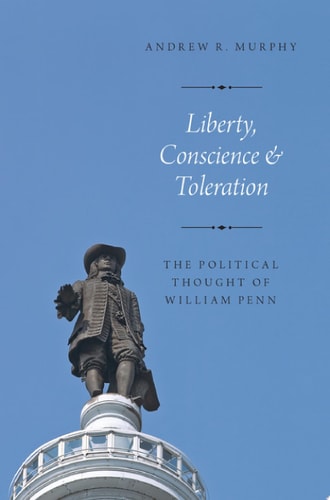
Liberty, Conscience, and Toleration: The Political Thought of William Penn
0
0
As an Amazon Associate and affiliate partner, Menrva Books earns from qualifying purchases. Learn more
Author Description
In a seventeenth-century English landscape populated with towering political and philosophical figures like Hobbes, Harrington, Cromwell, Milton, and Locke, William Penn remains in many ways a man apart. Yet despite being widely neglected by scholars, he was a sophisticated political thinker who contributed mightily to the theory and practice of religious liberty in the early modern Atlantic world. In this long-awaited intellectual biography of William Penn, Andrew R. Murphy presents a nuanced portrait of this remarkable entrepreneur, philosopher, Quaker, and politician.Liberty, Conscience, and Toleration focuses on the major political episodes that attracted William Penn's sustained attention as a political thinker and actor: the controversy over the Second Conventicle Act, the Popish Plot and Exclusion Crisis, the founding and settlement of Pennsylvania, and the contentious reign of James II. Through a careful examination of writings published in the midst of the religious and political conflicts of Restoration and Revolutionary England, Murphy contextualizes the development of Penn's thought in England and America, illuminating the mutual interconnections between Penn's political thought and his colonizing venture in America. An early advocate of representative institutions and religious freedom, William Penn remains a singular figure in the history of liberty of conscience. His political theorizing provides a window into the increasingly vocal, organized, and philosophically sophisticated tolerationist movement that gained strength over the second half of the seventeenth century. Not only did Penn attempt to articulate principles of religious liberty as a Quaker in England, but he actually governed an American polity and experienced firsthand the complex relationship between political theory and political practice. Murphy's insightful analysis shows Penn's ongoing significance to the broader study of Anglo-American political theory and practice, ultimately point
Menrva's Summary
THE THESIS
This work investigates how William Penn functioned as a sophisticated political theorist whose advocacy for religious liberty and representative institutions shaped the early modern Atlantic world. Andrew R. Murphy, a scholar of political theory, utilizes a comprehensive examination of Penn's writings and his practical experiences as a colonial governor to challenge the historical neglect of Penn's intellectual contributions. The book argues that Penn's political thought was not merely abstract but was deeply integrated into the religious and political conflicts of seventeenth-century England and the practical realities of governing Pennsylvania.
THE SCOPE MAP
What You Will Find
- Analysis of major political episodes including the Second Conventicle Act and the Exclusion Crisis.
- Examination of the intersection between Quaker theology and political governance.
- Contextualization of Penn's thought within the broader seventeenth-century tolerationist movement.
Scope Limits
- The text does not provide a comprehensive personal biography of Penn's private life outside of his political and intellectual activities.
- It does not offer an exhaustive history of the entire American colonial period, focusing instead on the specific political theories relevant to Penn's governance.
THE AUTHORITY PERSPECTIVE
Scholars and historians recognize this text as a significant contribution to the study of early modern political thought, particularly for its focus on the practical application of theory in colonial governance. Readers frequently note the academic rigor of the prose and the author's success in positioning Penn alongside contemporaries like Locke and Milton.
Page Count:
320
Publication Date:
2016-01-01
Publisher:
Oxford University Press
ISBN-10:
0190612878
ISBN-13:
9780190612870
Philosophy
History
Biography
Liberty
History - Modern
Religious tolerance
Modern History
Freedom of religion
Special Topics
Community Tags
Similar Books