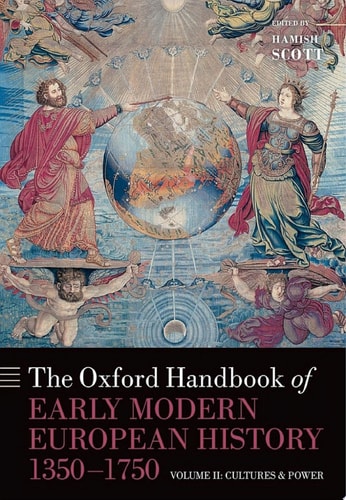
The Oxford Handbook of Early Modern European History, 1350-1750: Volume II: Cultures and Power
0
0
As an Amazon Associate and affiliate partner, Menrva Books earns from qualifying purchases. Learn more
Author Description
This Handbook re-examines the concept of early modern history in a European and global context. The term 'early modern' has been familiar, especially in Anglophone scholarship, for four decades and is securely established in teaching, research, and scholarly publishing. More recently, however, the unity implied in the notion has fragmented, while the usefulness and even the validity of the term, and the historical periodisation which it incorporates, have been questioned. The Oxford Handbook of Early Modern European History, 1350-1750 provides an account of the development of the subject during the past half-century, but primarily offers an integrated and comprehensive survey of present knowledge, together with some suggestions as to how the field is developing. It aims both to interrogate the notion of 'early modernity' itself and to survey early modern Europe as an established field of study. The overriding aim will be to establish that 'early modern' is not simply a chronological label but possesses a substantive integrity. Volume II is devoted to 'Cultures and Power', opening with chapters on philosophy, science, art and architecture, music, and the Enlightenment. Subsequent sections examine 'Europe beyond Europe', with the transformation of contact with other continents during the first global age, and military and political developments, notably the expansion of state power.
Menrva's Summary
THE THESIS
This volume investigates whether the concept of 'early modern' history maintains substantive integrity as a periodization or if it has fragmented under recent scholarly scrutiny. Hamish Scott, a prominent historian of early modern Europe, compiles contributions from leading experts to synthesize current research. The work argues that despite challenges to the term's validity, early modern Europe remains a coherent and vital field of study that bridges the gap between the medieval and modern eras through an integrated analysis of cultural and political developments.
THE SCOPE MAP
What You Will Find
- Comprehensive analysis of philosophy, science, art, architecture, and music during the 1350-1750 period.
- Examination of the Enlightenment and its intellectual foundations.
- Studies on 'Europe beyond Europe' and the impact of global contact.
- Analysis of military evolution and the expansion of state power.
Scope Limits
- The volume focuses specifically on the 'Cultures and Power' thematic pillar rather than providing a general chronological narrative.
- It does not cover the entirety of early modern history, as social and economic structures are primarily addressed in the companion volume.
THE AUTHORITY PERSPECTIVE
Scholars and students of history recognize this handbook as a foundational reference for understanding the complexities of the early modern period. Readers frequently note the academic density of the prose, which is intended for advanced students and professional historians.
Page Count:
759
Publication Date:
2015-01-01
Publisher:
OUP Oxford
ISBN-10:
019102001X
ISBN-13:
9780191020018
Philosophy
History
Special Topics
European History
History & Surveys
History - Modern
Political History
History of the Americas
Europe
Cultural History
World Civilization
Community Tags
Similar Books