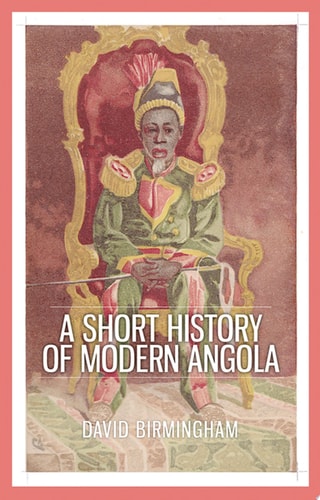
A Short History of Modern Angola
0
0
As an Amazon Associate and affiliate partner, Menrva Books earns from qualifying purchases. Learn more
Author Description
This history by celebrated Africanist David Birmingham begins in 1820 with the Portuguese attempt to create a third, African, empire after the virtual loss of Asia and America. In the nineteenth century the most valuable resource extracted from Angola was agricultural labor, first as privately owned slaves and later as conscript workers. The colony was managed by a few marine officers, by several hundred white political convicts, and by a couple of thousand black Angolans who had adopted Portuguese language and culture. The hub was the harbor city of Luanda which grew in the twentieth century to be a dynamic metropolis of several million people. The export of labor was gradually replaced when an agrarian revolution enabled white Portuguese immigrants to drive black Angolan laborers to produce sugar cane, cotton, maize and above all coffee.During the twentieth century Congo copper supplemented this wealth, by gem-quality diamonds, and by offshore oil. Although much of the countryside retained its dollar-a-day peasant economy, new wealth generated conflict which pitted white against black, north against south, coast against highland, American allies against Russian allies. The generation of warfare finally ended in 2002 when national reconstruction could begin on Portuguese colonial foundations.
Menrva's Summary
THE THESIS
This work investigates the historical trajectory of Angola from 1820 to the early 21st century, focusing on the transition from colonial exploitation to national reconstruction. David Birmingham, a recognized scholar in African studies, utilizes a chronological framework to analyze how the extraction of labor and natural resources shaped the socio-political landscape of the region. The text argues that the structural foundations laid during the Portuguese colonial era directly influenced the subsequent conflicts and economic developments of the twentieth century.
THE SCOPE MAP
What You Will Find
- Analysis of the Portuguese colonial administration and its reliance on agricultural labor.
- Examination of the transition from slave labor to conscripted labor and agrarian production.
- Historical overview of the impact of resource extraction, including copper, diamonds, and oil.
- Contextualization of the civil warfare that defined the late twentieth century.
Scope Limits
- The text does not provide an exhaustive day-to-day account of the post-2002 reconstruction period.
- It does not focus on detailed biographical accounts of individual political figures.
THE AUTHORITY PERSPECTIVE
Experts frequently cite this work as a foundational text for understanding the complex colonial history of Angola. Readers often note the clarity of the prose, which effectively synthesizes dense historical data into a coherent narrative for both students and general historians.
Page Count:
159
Publication Date:
2016-01-01
Publisher:
Oxford University Press
ISBN-10:
0190613459
ISBN-13:
9780190613457
History
Angola
Angola_history
Slavery africa
African history
Colonialism
Community Tags
Other Editions(4)
Similar Books