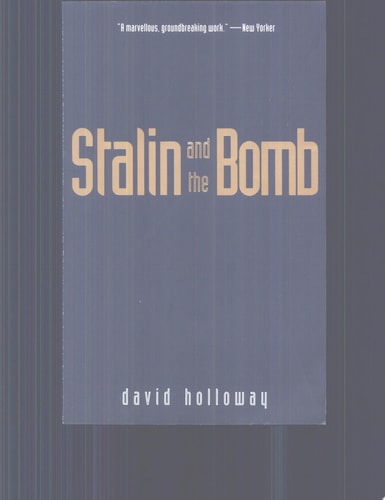
Stalin and the Bomb: The Soviet Union and Atomic Energy, 1939-1956
0
0
As an Amazon Associate and affiliate partner, Menrva Books earns from qualifying purchases. Learn more
Author Description
For forty years the Soviet-American nuclear arms race dominated world politics, yet the Soviet nuclear establishment was shrouded in secrecy. Now that the Cold War is over and the Soviet Union has collapsed, it is possible to answer questions that have intrigued policymakers and the public for years. How did the Soviet Union build its atomic and hydrogen bombs? What role did espionage play? How did the American atomic monopoly affect Stalin's foreign policy? What was the relationship between Soviet nuclear scientists and the country's political leaders? This spellbinding book answers these questions by tracing the history of Soviet nuclear policy from developments in physics in the 1920s to the testing of the hydrogen bomb and the emergence of nuclear deterrence in the mid-1950s. In engrossing detail, David Holloway tells how Stalin launched a crash atomic program only after the Americans bombed Hiroshima and showed that the bomb could be built; how the information handed over to the Soviets by Klaus Fuchs helped in the creation of their first bomb; how the scientific intelligentsia, which included such men as Andrei Sakharov, interacted with the police apparatus headed by the suspicious and menacing Lavrentii Beria; what steps Stalin took to counter U.S. atomic diplomacy; how the nuclear project saved Soviet physics and enabled it to survive as an island of intellectual autonomy in a totalitarian society; and what happened when, after Stalin's death, Soviet scientists argued that a nuclear war might extinguish all life on earth. This magisterial history throws light on Soviet policy at the height of the Cold War, illuminates a central but hitherto secret element of the Stalinist system, and puts into perspective the tragic legacy of this program today--environmental damage, a vast network of institutes and factories, and a huge stockpile of unwanted weapons.
Menrva's Summary
THE THESIS
This book investigates the history of the Soviet Union's atomic energy program and its role in the Cold War nuclear arms race, from its origins in the 1930s to the mid-1950s. David Holloway, drawing on newly accessible archives following the collapse of the Soviet Union, details the clandestine development of Soviet nuclear weapons. The narrative traces the program's inception, the crucial role of espionage, the impact of the American atomic monopoly on Stalin's foreign policy, and the complex relationship between Soviet scientists and political leadership, particularly Lavrentii Beria.
THE SCOPE MAP
- The history of Soviet nuclear policy from the 1920s to the mid-1950s.
- The impact of espionage, including the role of Klaus Fuchs.
- The relationship between Soviet scientists (like Andrei Sakharov) and political leaders (like Lavrentii Beria).
- Stalin's response to the American atomic bomb and his foreign policy decisions.
- The survival and autonomy of Soviet physics within a totalitarian society.
- The debates among scientists after Stalin's death regarding nuclear war.
THE AUTHORITY PERSPECTIVE
This magisterial history has been widely acclaimed for its comprehensive and detailed account of the Soviet nuclear program. Experts recognize Holloway's meticulous research, which draws on previously secret archives, as shedding crucial light on a central, yet long-obscured, element of the Stalinist system and the Cold War. The book is praised for putting into perspective the program's lasting legacy, including environmental consequences and the vast infrastructure it created. It is considered an essential read for understanding Soviet policy and the nuclear age.
Page Count:
464
Publication Date:
1994-01-01
Publisher:
Yale University Press
ISBN-10:
0300066643
ISBN-13:
9780300066647
Science
History
Politics
Non-Fiction
Community Tags
Similar Books














