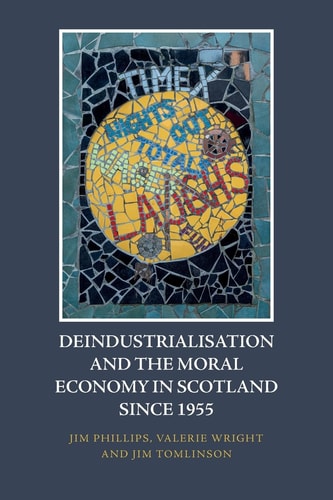
Deindustrialisation and the Moral Economy in Scotland Since 1955
0
0
As an Amazon Associate and affiliate partner, Menrva Books earns from qualifying purchases. Learn more
Author Description
Deindustrialisation is the central feature of Scotland's economic, social and political history since the 1950s, when employment levels peaked in the established sectors of coal, shipbuilding, metals and textiles, along with the railways and docks. This book moves analysis beyond outmoded tropes of economic decline and industrial catastrophe, and instead examines the political economy of deindustrialisation with a sharp eye on cultural and social dimensions that were not uniformly negative, as often assumed. Viewing the long-term process of deindustrialisation through a moral economy framework, the book carefully reconstructs the impact of economic change on social class, gender relations and political allegiances, including a reawakened sense of Scottish national identity. In doing so, it reveals deindustrialisation as a more complex process than the customary body count of closures and job losses suggests, and demonstrates that socioeconomic change did not just happen, but was influenced by political agency.
Menrva's Summary
THE THESIS
This book investigates the complex political economy of deindustrialisation in Scotland since the 1950s, moving beyond simplistic narratives of decline. It examines how the decline of traditional industries like coal, shipbuilding, and textiles reshaped Scottish society, focusing on the cultural and social dimensions that were not uniformly negative. By employing a moral economy framework, the authors reconstruct the impact of these economic changes on social class, gender relations, political allegiances, and the emergence of Scottish national identity, revealing a more nuanced process than mere job losses suggest.
THE SCOPE MAP
- Analysis of deindustrialisation in Scotland from 1955 onwards.
- Application of a moral economy framework to understand socioeconomic change.
- Reconstruction of the impact on social class, gender relations, and political allegiances.
- Exploration of the reawakened sense of Scottish national identity.
- Demonstration of political agency influencing socioeconomic change.
- Critique of outmoded tropes of economic decline and industrial catastrophe.
THE AUTHORITY PERSPECTIVE
This book offers a detailed examination of Scotland's deindustrialisation, utilizing a moral economy framework to provide a nuanced perspective. It moves beyond traditional economic analyses to explore the cultural and social impacts, including shifts in class, gender, and national identity. The authors highlight the role of political agency in shaping these profound socioeconomic changes. The work is positioned as a significant contribution to understanding modern Scottish history.
Page Count:
296
Publication Date:
2023-05-22
Publisher:
Edinburgh University Press
ISBN-10:
1474479251
ISBN-13:
9781474479257
Economics
Non-Fiction
History
Scottish History
Social History
Community Tags
Other Editions(2)

Similar Books