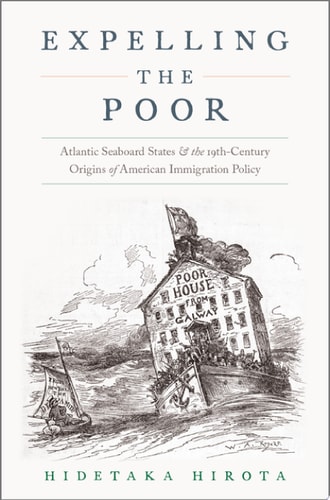
Expelling the Poor
0
0
As an Amazon Associate and affiliate partner, Menrva Books earns from qualifying purchases. Learn more
Author Description
Historians have long assumed that immigration to the United States was free from regulation until anti-Asian racism on the West Coast triggered the introduction of federal laws to restrict Chinese immigration in the 1880s. Studies of European immigration and government control on the East Coast have, meanwhile, focused on Ellis Island, which opened in 1892. In this work, Hidetaka Hirota reinterprets the origins of immigration restriction in the United States, especially deportation policy, offering the first sustained study of immigration control conducted by states prior to the introduction of federal immigration law. Faced with the influx of impoverished Irish immigrants over the first half of the nineteenth century, nativists in New York and Massachusetts built upon colonial poor laws to develop policies for prohibiting the landing of destitute foreigners and deporting those already resident to Europe, Canada, or other American states. These policies laid the foundations for federal immigration law. By investigating state officials' practices of illegal removal, including the overseas deportation of citizens, this book reveals how the state-level treatment of destitute immigrants set precedents for the use of unrestricted power against undesirable aliens. It also traces the transnational lives of the migrants from their initial departure from Ireland and passage to North America through their expulsion from the United States and postdeportation lives in Europe, showing how American deportation policy operated as part of the broader exclusion of nonproducing members from societies in the Atlantic world. By locating the roots of American immigration control in cultural prejudice against the Irish and, more essentially, economic concerns about their poverty in nineteenth-century New York and Massachusetts, Expelling the Poor fundamentally revises the history of American immigration policy.
Menrva's Summary
THE THESIS
This book investigates the origins of American immigration restriction by arguing that state-level policies targeting impoverished Irish immigrants in the mid-nineteenth century established the legal and practical foundations for federal deportation laws. Hidetaka Hirota, a historian specializing in nineteenth-century American immigration, utilizes archival records from New York and Massachusetts to demonstrate how local nativist movements utilized colonial poor laws to manage and expel destitute foreigners. The work challenges the conventional narrative that federal immigration control began solely with anti-Asian legislation in the 1880s, instead positioning state-level economic concerns as the primary driver of early exclusionist practices.
THE SCOPE MAP
What You Will Find
- Analysis of state-level immigration control in New York and Massachusetts prior to federal oversight.
- Examination of the transition from colonial poor laws to modern deportation policies.
- Investigation into the transnational experiences of Irish migrants, including their departure, arrival, and subsequent expulsion.
- Documentation of the use of unrestricted state power against non-producing members of society.
Scope Limits
- The study focuses primarily on the mid-nineteenth century and does not cover the full breadth of twentieth-century federal immigration policy.
- The geographic scope is limited to the East Coast, specifically New York and Massachusetts, rather than providing a comprehensive national survey of all states.
THE AUTHORITY PERSPECTIVE
Scholars and historians recognize this work as a significant contribution to the field of immigration history for its focus on the pre-federal era. Readers frequently note the academic rigor and the depth of archival research used to connect local economic policies to the development of national deportation frameworks.
Page Count:
320
Publication Date:
2016-01-01
Publisher:
Oxford University Press
ISBN-10:
0190619228
ISBN-13:
9780190619220
History
American History
Immigration Policy
Social History
19th Century
Community Tags
Other Editions(2)

Similar Books






Reader Comments
Share Your Thoughts
No comments yet. Be the first to share your thoughts!