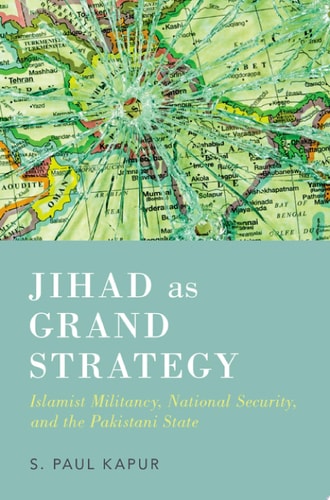
Jihad as Grand Strategy: Islamist Militancy, National Security, and the Pakistani State
0
0
As an Amazon Associate and affiliate partner, Menrva Books earns from qualifying purchases. Learn more
Author Description
Islamist militants based in Pakistan have played a major role in terrorism around the world and pose a significant threat to regional and international security. Although the Pakistan-militant connection has received widespread attention only in recent years, it is not a new phenomenon. Pakistan has, since its inception in the wake of World War II, used Islamist militants to wage jihad in order to compensate for severe political and material weakness. This use of militancy has become so important that it is now a central component of Pakistani grand strategy; supporting jihad is one of the principal means by which the Pakistani state seeks to produce security for itself. Contrary to conventional wisdom, the strategy has not been wholly disastrous. It has achieved important domestic and international successes, enabling Pakistan to confront stronger adversaries and shape its strategic environment without the costs and risks of direct combat, and to help promote internal cohesion to compensate for its weak domestic political foundations. Recently, however, these successes of Pakistan's militant strategy have given way to serious problems. The militant organizations that Pakistan nurtured over the decades are increasingly exceeding its control; continued support for jihad diverts scarce resources from pressing domestic projects, impeding the country's internal development; and the militant campaign's repeated provocations have led India to adopt a more aggressive conventional military posture. As Paul Kapur shows in Jihad as Grand Strategy, these developments significantly undermine Pakistani interests, threatening to leave it less politically cohesive and externally secure than it was before. Thus, despite its past benefits, the strategy has outlived its utility, and Pakistan will have to abandon it in order to avoid catastrophe. This will require not simply a change of policy, but a thoroughgoing reconceptualization of the Pakistani state.
Menrva's Summary
THE THESIS
Does the Pakistani state's historical reliance on Islamist militancy as a strategic tool remain a viable method for ensuring national security in the contemporary era? Paul Kapur, a scholar specializing in nuclear proliferation and South Asian security, examines the historical trajectory of Pakistan's state-sponsored militancy. He argues that while the use of jihadist proxies once served as a rational, low-cost mechanism to offset material weakness against stronger adversaries, the strategy has reached a point of diminishing returns. The text posits that the current alignment of these militant groups now actively destabilizes the state, necessitating a fundamental shift in national policy to avoid systemic collapse.
THE SCOPE MAP
What You Will Find
- Historical analysis of Pakistan's security policies from the post-World War II era to the present.
- A strategic framework evaluating the utility of proxy warfare in asymmetric conflicts.
- Assessment of the shifting power dynamics between the Pakistani state and non-state militant actors.
Scope Limits
- The book does not provide a detailed tactical manual for counter-terrorism operations.
- It does not offer a comprehensive history of all individual militant organizations operating within the region.
THE AUTHORITY PERSPECTIVE
Experts in South Asian security identify this work as a rigorous examination of the rationales behind state-sponsored proxy warfare. Readers frequently note the academic density of the prose and the author's objective approach to a highly contentious geopolitical subject.
Page Count:
184
Publication Date:
2016-01-01
Publisher:
Oxford University Press
ISBN-10:
0190611839
ISBN-13:
9780190611835
Pakistan
Middle Eastern
International Security
Military Strategy
Jihad
International relations
National security
Community Tags
Similar Books