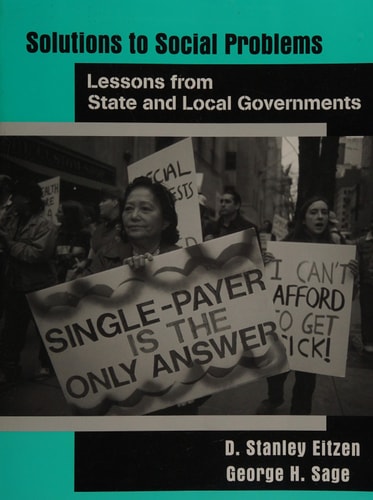
Solutions to Social Problems: Lessons from State and Local Governments
0
0
As an Amazon Associate and affiliate partner, Menrva Books earns from qualifying purchases. Learn more
Author Description
This text examines specific cases where states and cities are ahead of the federal government in providing solutions to social problems. States and cities are sometimes ahead of the federal government in providing solutions to social problems. The federal bureaucracy often prefers no change to change. Congress is sometimes paralyzed by party and ideological differences resulting in stagnation. In this vacuum, some states provide innovative programs to solve social problems that may be applicable at the federal level. This book examines specific examples of state and local initiatives to solve these representative social problems: undemocratic practices, poverty, inadequate wages for the working poor, unequal educational opportunity by class and race, the inadequate and inefficient health care system, the environmental crisis, and the decaying or inadeq
Menrva's Summary
THE THESIS
This text investigates whether state and local governments serve as more effective laboratories for social policy innovation than the often-stagnant federal bureaucracy. Authors D. Stanley Eitzen and George H. Sage, both established scholars in sociology, utilize a comparative framework to analyze how sub-national entities navigate systemic issues. By contrasting federal inertia with localized experimentation, the authors argue that state-level initiatives provide scalable models for addressing pervasive national challenges.
THE SCOPE MAP
What You Will Find
- Case studies of state and local policy initiatives addressing poverty and wage inequality.
- Analysis of educational disparities categorized by class and race.
- Evaluation of health care system inefficiencies and environmental policy responses.
- A comparative methodology contrasting federal legislative paralysis with regional innovation.
THE AUTHORITY PERSPECTIVE
The subject matter points to a dense, academic exploration of public policy that is intended for students of sociology and political science. The framing suggests a focus on practical governance and the structural limitations of the federal system in the early 21st century.
Page Count:
168
Publication Date:
2008-07-20
Publisher:
Pearson
ISBN-10:
020557873X
ISBN-13:
9780205578733
United States
Public Policy
Sociology
Community Tags
Similar Books