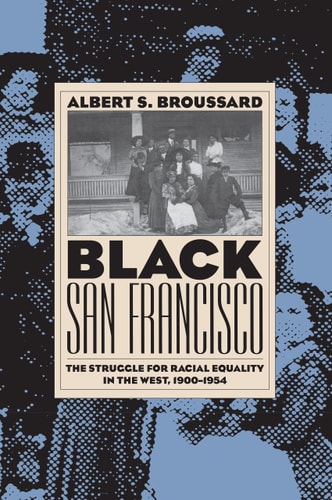
Black San Francisco: The Struggle for Racial Equality in the West, 1900–1954
0
0
As an Amazon Associate and affiliate partner, Menrva Books earns from qualifying purchases. Learn more
Author Description
By 1867 black San Franciscans had gained access to public transportation. In 1869 they were granted the right to vote by the state of California. In 1875 they fought for desegregated schools and won. Yet in 1957, Willie Mays was initially denied the opportunity to purchase a home in an exclusive San Francisco neighborhood because he was black. In Black San Francisco, Albert Broussard explores race relations in a city where whites, for the most part, were outwardly civil to blacks while denying them employment opportunities and political power. Understanding the texture of the racial caste system, he argues, is critical to understanding why blacks made so little progress in employment, housing, and politics despite the absence of segregation laws. When it came to racial equality in the early twentieth century, Broussard argues, the liberal progressive image of San Francisco was largely a facade. Illustrating how black San Franciscans struggled to achieve equality in the same manner as their counterparts in the Midwest and East, he challenges the rhetoric of progress and opportunity with evidence of the reality of inequality for black San Franciscans. Black San Francisco is considerably broader in scope than any previous study of African-Americans in the West. It provides extensive coverage of the city's black community during the Great Depression and the New Deal, details civil rights activities from 1915 to 1954, and provides extensive biographical material on local black leaders. In his reconstruction of the plight of San Francisco's black citizens, Broussard reveals a population that, despite its small size before 1940, did not accept second-class citizenship passively yet remained nonviolent into the 1960s. He also shows how World War II was a watershed for Black San Francisco, bringing thousands of southern migrants to the bay area to work in the war industries. These migrants, in tandem with native black residents, formed coalitions
Menrva's Summary
THE THESIS
The liberal progressive image of San Francisco was largely a facade when it came to racial equality in the early twentieth century. Albert Broussard explores the complex race relations in San Francisco between 1900 and 1954, a period where outward civility often masked systemic denial of employment opportunities and political power to Black residents. He argues that understanding the subtle texture of this racial caste system is crucial to comprehending the limited progress in housing, employment, and politics despite the absence of overt segregation laws. The book challenges the prevailing narrative of progress by presenting evidence of persistent inequality for Black San Franciscans, illustrating their struggle for equality in a manner comparable to their counterparts in the Midwest and East.
THE SCOPE MAP
- Extensive coverage of San Francisco's Black community during the Great Depression and the New Deal.
- Detailed account of civil rights activities from 1915 to 1954.
- Biographical material on local Black leaders.
- Analysis of the racial caste system and its impact on employment, housing, and politics.
- Exploration of the role of World War II in transforming the Black community through migration and coalition-building.
- Examination of the nonviolent struggle for equality by Black San Franciscans into the 1960s.
THE AUTHORITY PERSPECTIVE
Albert Broussard's "Black San Francisco" is recognized as a significant contribution to the study of African-Americans in the West, offering a broader scope than previous works. The book is noted for its detailed reconstruction of the challenges faced by Black San Franciscans, highlighting their active, nonviolent resistance to second-class citizenship. It effectively challenges the city's progressive image by revealing the underlying realities of racial inequality. The work is particularly praised for its coverage of the Great Depression, New Deal era, and the transformative impact of World War II on the city's Black population.
Page Count:
336
Publication Date:
1993-04-26
Publisher:
University Press of Kansas
ISBN-10:
070060684X
ISBN-13:
9780700606849
History
Non-Fiction
Social History
Urban History
Community Tags
Similar Books