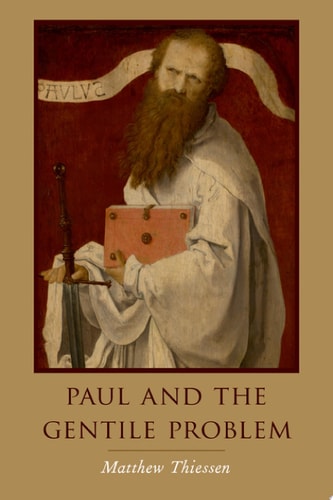
Paul and the Gentile Problem
0
0
As an Amazon Associate and affiliate partner, Menrva Books earns from qualifying purchases. Learn more
Author Description
Paul and the Gentile Problem provides a new explanation for the apostle Paul's statements about the Jewish law in his letters to the Romans and Galatians. Paul's arguments against circumcision and the law in Romans 2 and his reading of Genesis 15-21 in Galatians 4:21-31 belong within a stream of Jewish thinking which rejected the possibility that gentiles could undergo circumcision and adopt the Jewish law, thereby becoming Jews. Paul opposes this solution to the gentile problem because he thinks it misunderstands how essentially hopeless the gentile situation remains outside of Christ. The second part of the book moves from Paul's arguments against a gospel that requires gentiles to undergo circumcision and adoption of the Jewish law to his own positive account, based on his reading of the Abraham Narrative, of the way in which Israel's God relates to gentiles. Having received the Spirit (pneuma) of Christ, gentiles are incorporated into Christ, who is the singular seed of Abraham, and, therefore, become materially related to Abraham. But this solution raises a question: Why is it so important for Paul that gentiles become seed of Abraham? The argument of this book is that Paul believes that God had made certain promises to Abraham that only those who are his seed could enjoy and that these promises can be summarized as being empowered to live a moral life, inheriting the cosmos, and having the hope of an indestructible life.
Menrva's Summary
THE THESIS
This book investigates the core theological question of why the apostle Paul insisted that Gentiles should not undergo circumcision or adopt the Jewish law to be included in the covenant. Matthew Thiessen, a scholar of early Christianity, utilizes a historical-critical framework to situate Paul within the context of Second Temple Jewish thought. He argues that Paul’s opposition to the circumcision of Gentiles is rooted in a specific reading of the Abrahamic narrative, asserting that Gentiles are incorporated into Christ—the singular seed of Abraham—rather than becoming Jews through the law.
THE SCOPE MAP
What You Will Find
- An analysis of Paul’s arguments in the epistles to the Romans and Galatians.
- A historical examination of Second Temple Jewish perspectives on Gentile conversion.
- A detailed reading of the Genesis 15-21 Abraham narrative as interpreted by Paul.
- An exploration of the theological implications of the Spirit (pneuma) in Gentile inclusion.
Scope Limits
- The book does not provide a comprehensive commentary on all Pauline epistles.
- It does not focus on the broader historical biography of Paul outside of his theological arguments regarding the law.
THE AUTHORITY PERSPECTIVE
Scholars and students of New Testament theology frequently note the academic density and rigorous historical methodology employed by Thiessen. Experts highlight this work as a significant contribution to the 'Paul within Judaism' perspective, often citing it as a necessary text for understanding the complexities of early Christian identity formation.
Page Count:
329
Publication Date:
2016-01-01
Publisher:
Oxford University Press
ISBN-10:
0190613947
ISBN-13:
9780190613945
Religion
Christianity - History
Christian Theology
Bibles
New Testament
Judaism
Community Tags
Other Editions(3)
Similar Books