
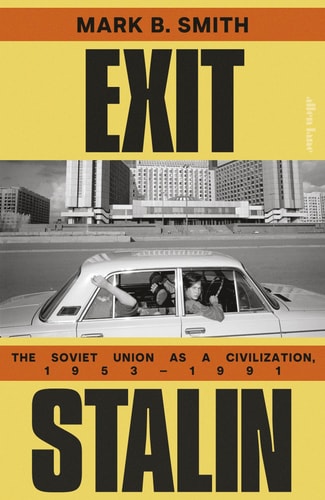
Exit Stalin: The Soviet Union as a Civilization, 1953-1991
0
0
As an Amazon Associate and affiliate partner, Menrva Books earns from qualifying purchases. Learn more
Author Description
A "Best Non-Fiction to Read This Year" Selection from The New Statesman A magisterial, revisionist narrative history of the Soviet Union in its post-Stalin heyday, bringing a forgotten society to vivid life and offering a new explanation for how it suddenly collapsed. To those of us in the West, the Soviet Union is synonymous with Stalinism. The common view of the USSR is of a brutal regime that squelched dissent and oversaw a drab, terrified society. Yet as Cambridge historian Mark B. Smith demonstrates in Exit Stalin, after the death of the murderous Joseph Stalin in 1953, the Soviet Union was at a crossroads. Would it break from the dictator’s reign or continue his campaign of violence and fear? The answer was both. The USSR remained harsh and authoritarian, yet it also earnestly sought to fulfill the Russian Revolution’s promise of an egalitarian, progressive future. Smith shows how vacation resorts, Pioneer camps, and new opportunities for private life coexisted with corruption scandals, KGB surveillance, and censorship. Re-creating the everyday rhythms of the country, he takes us into the Soviet Union’s culture, including TV shows and films that were little-known in the West. Ordinary citizens navigated the contradictions of existence under Khrushchev and his successors, building lives within a system they often accepted, believed in, or could not imagine abandoning. The result was the emergence of a distinctive and functioning civilization, a far cry from the vicious dictatorship of the West’s imagination. A brilliantly original narrative of ordinary life in the late Soviet Union, Exit Stalin also presents a new account of its end, showing how a series of unexpected decisions unraveled the entire project. Ultimately, Smith reveals that the shortages, coercion, and incompetence that underlaid the USSR—and that by the late 1980s would doom it—have to be understood alongside the acceptance it always had from most of its citizens.
Menrva's Summary
THE THESIS
The post-Stalin Soviet Union presented a complex duality, attempting to reconcile revolutionary ideals with authoritarian control. Mark B. Smith, a historian from Cambridge, argues that after 1953, the USSR was not solely defined by repression but also by efforts to achieve an egalitarian future, even as it maintained a harsh political climate. This narrative history explores the coexistence of state-sanctioned leisure and private life with surveillance and censorship. Smith reconstructs the daily existence of ordinary citizens, examining their engagement with a system they often accepted or could not envision leaving, thereby forging a distinct civilization.
THE SCOPE MAP
- Analysis of the Soviet Union's trajectory following Joseph Stalin's death in 1953.
- Exploration of the coexistence of authoritarianism with attempts at egalitarianism and progressive futures.
- Examination of everyday life, including vacation resorts, Pioneer camps, and private life.
- Discussion of cultural elements such as TV shows and films largely unknown in the West.
- Investigation into the contradictions faced by citizens navigating corruption, KGB surveillance, and censorship.
- A new explanation for the Soviet Union's collapse, linked to unexpected decisions.
- Understanding of the underlying shortages, coercion, and incompetence alongside citizen acceptance.
- Revisionist perspective on the Soviet Union as a functioning civilization distinct from Western perceptions.
THE AUTHORITY PERSPECTIVE
The book has been recognized as a significant non-fiction read, earning a 'Best Non-Fiction to Read This Year' selection from The New Statesman. It is described as a magisterial and revisionist history that brings the post-Stalin Soviet Union to vivid life. The work is praised for offering a new explanation for the USSR's eventual collapse by examining the complex societal dynamics and citizen engagement. Its approach is noted for re-creating the everyday rhythms and cultural landscape of the country, presenting a nuanced view beyond the common perception of a brutal dictatorship.
Page Count:
576
Publication Date:
2026-04-28
Publisher:
W. W. Norton & Company
ISBN-10:
1631498304
ISBN-13:
9781631498305
History
Non-Fiction
Civilization
Cultural History
Soviet Union
Community Tags
Other Editions(2)
Similar Books





Reader Comments
Share Your Thoughts
No comments yet. Be the first to share your thoughts!