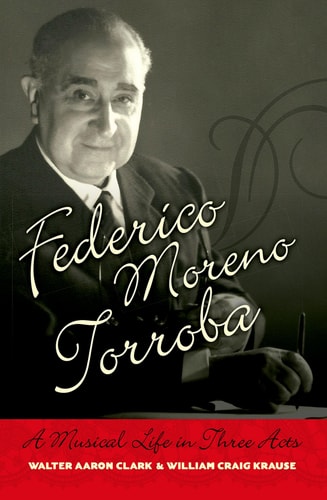
Federico Moreno Torroba: A Musical Life in Three Acts
0
0
As an Amazon Associate and affiliate partner, Menrva Books earns from qualifying purchases. Learn more
Author Description
The last of the Spanish Romantics, composer, conductor, and impresario Federico Moreno Torroba (1891-1982) left his mark on virtually every aspect of Spanish musical culture during a career which spanned six decades, and saw tremendous political and cultural upheavals. After Falla, he was the most important and influential musician: in addition to his creative activities, he was President of the General Society of Authors and Editors and director of the Academy of Fine Arts and Teatro Zarzuela. His enduring contributions as a composer include copious amounts of guitar music composed for Andres Segovia and several highly successful zarzuelas which remain in the repertoire today.Written by two leading experts in the field, Federico Moreno Torroba: A Musical Life in Three Acts explores not only his life and work, but also the relationship of his music to the cultural milieu in which he moved. It sheds particular light on the relationship of Torroba's music and the cultural politics of Francisco Franco's dictatorship (1939-75). Torroba came of age in a cultural renaissance that sought to reassert Spain's position as a unique cultural entity, and authors Walter A. Clark and William Krause demonstrate how his work can be understood as a personal, musical response to these aspirations. Clark and Krause argue that Torroba's decision to remain in Spain even during the years of Franco's dictatorship was based primarily not on political ideology but rather on an unwillingness to leave his native soil. Rather than abandon Spain to participate in the dynamic musical life abroad, he continued to compose music that reflected his conservative view of his national and personal heritage. The authors contend that this pursuit did not necessitate allegiance to a particular regime, but rather to the non-political exaltation of Spain's so-called 'eternal tradition', or the culture and spirit that had endured throughout Spain's turbulent history.Following Franco's death in 1975, there was
Menrva's Summary
THE THESIS
This work investigates how Federico Moreno Torroba navigated the complex intersection of Spanish musical tradition and the political constraints of the Franco dictatorship. Authors Walter Aaron Clark and William Craig Krause, both established experts in Iberian musicology, utilize archival research and musical analysis to argue that Torroba’s creative output was driven by a commitment to Spanish cultural heritage rather than political alignment with the regime. The text frames his career as a deliberate effort to preserve a national musical identity amidst significant historical upheaval.
THE SCOPE MAP
What You Will Find
- A comprehensive biographical account of Torroba’s six-decade career.
- Analysis of his contributions to the zarzuela genre and guitar repertoire.
- Examination of the cultural politics within Spain from 1939 to 1975.
- Contextualization of his relationship with Andres Segovia.
Scope Limits
- The text does not provide an exhaustive technical musicological analysis of every individual composition.
- It does not focus on the international reception of his work outside of the Iberian context.
THE AUTHORITY PERSPECTIVE
Experts recognize this volume as a definitive scholarly resource for understanding the life and cultural impact of a pivotal Spanish composer. Readers frequently note the academic density of the prose, which provides a rigorous look at the intersection of art and political history.
Page Count:
400
Publication Date:
2016-11-01
Publisher:
Oxford University Press
ISBN-10:
0190628464
ISBN-13:
9780190628468
Biography
Composers
Music History
Spanish Culture
Composers spain
Musicology
Community Tags
Other Editions(3)
Similar Books
Reader Comments
Share Your Thoughts
No comments yet. Be the first to share your thoughts!