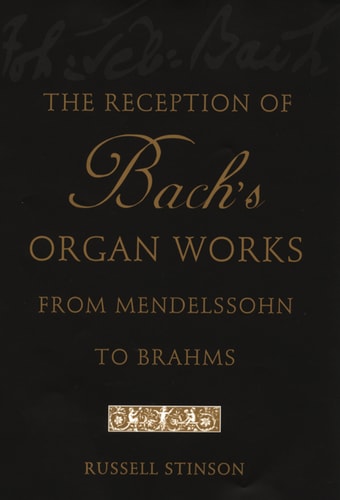
The Reception of Bach's Organ Works from Mendelssohn to Brahms
0
0
As an Amazon Associate and affiliate partner, Menrva Books earns from qualifying purchases. Learn more
Author Description
In this penetrating study, Russell Stinson explores how four of the greatest composers of the nineteenth century--Felix Mendelssohn, Robert Schumann, Franz Liszt, and Johannes Brahms--responded to the model of Bach's organ music. The author shows that this quadrumvirate not only borrowed from Bach's organ works in creating their own masterpieces, whether for keyboard, voice, orchestra, or chamber ensemble, but that they also reacted significantly to the music as performers, editors, theorists, and teachers. Furthermore, the book reveals how these four titans influenced one another as "receptors" of this repertory and how their mutual acquaintances--especially Clara Schumann--contributed as well. As the first comprehensive discussion of this topic ever attempted, Stinson's book represents a major step forward in the literature on the so-called Bach revival. He considers biographical as well as musical evidence to arrive at a host of new and sometimes startling conclusions. Filled with fascinating anecdotes, the study also includes detailed observations on how these composers annotated their personal copies of Bach's organ works. Stinson's book is entirely up-to-date and offers much material previously unavailable in English. It is meticulously annotated and indexed, and it features numerous musical examples and facsimile plates as well as an exhaustive bibliography. Included in an appendix is Brahms's hitherto unpublished study score of the Fantasy in G Major, BWV 572. Engagingly written, this study should be read by anyone at all interested in the music of Bach or the music of the nineteenth century.
Menrva's Summary
THE THESIS
This study investigates how four prominent nineteenth-century composers—Felix Mendelssohn, Robert Schumann, Franz Liszt, and Johannes Brahms—engaged with and were influenced by the organ works of J.S. Bach. Russell Stinson, a scholar of music history, utilizes a combination of biographical research, musical analysis, and archival evidence to demonstrate how these composers integrated Bach's influence into their own creative outputs. By examining their roles as performers, editors, and teachers, the author argues that these figures were not merely passive admirers but active participants in the nineteenth-century Bach revival.
THE SCOPE MAP
What You Will Find
- Analysis of how Mendelssohn, Schumann, Liszt, and Brahms incorporated Bachian elements into their own compositions.
- Examination of personal annotations found in the composers' private copies of Bach's organ scores.
- Discussion of the collaborative influence of figures such as Clara Schumann on the reception of this repertoire.
Scope Limits
- The study focuses specifically on the organ works of Bach rather than his entire body of work.
- The analysis is restricted to the reception history within the nineteenth-century German musical tradition.
THE AUTHORITY PERSPECTIVE
Musicologists frequently cite this work as a foundational text for understanding the intersection of Baroque legacy and Romantic composition. Experts highlight the meticulous archival research and the inclusion of previously unpublished materials as significant contributions to the field of musicology.
Page Count:
239
Publication Date:
2006-01-01
Publisher:
Oxford University Press
ISBN-10:
0190291087
ISBN-13:
9780190291082
Biography
Music History
Organ Music
Music Performance
Musicology
19th Century
Music
Humanities
Community Tags
Other Editions(3)
Similar Books

Reader Comments
Share Your Thoughts
No comments yet. Be the first to share your thoughts!