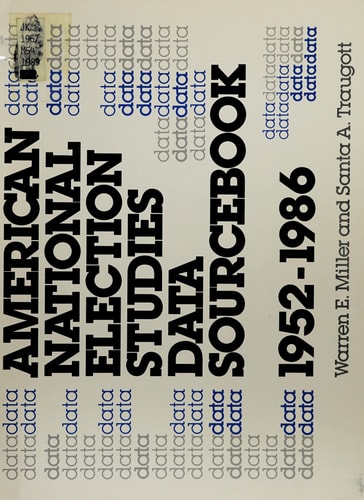
American National Election Studies Data Sourcebook, 1952-1986
0
0
As an Amazon Associate and affiliate partner, Menrva Books earns from qualifying purchases. Learn more
Author Description
Who votes in national elections? What are their preferences on issues? How important is their party identification? How does their demographic profile change over time? Reflecting an unbroken record of eighteen studies of voter behavior conducted biennially since 1952, this volume presents data on hundreds of elements influencing voters that will interest political scientists, journalists, consultants, and students of political history. The information was obtained from face-to-face interviews with national full probability samples of all citizens of voting age, as part of the University of Michigan/National Election Studies conducted by the Center for Political Studies. The data provide both an unrivaled occasion to gain a deeper understanding of congressional and presidential elections, and a basis for making or challenging broad generalizations about American politics since World War II. Major sections include personal characteristics (age, education, gender, religion, occupation, income, union membership, urbanism, race/ ethnicity); partisanship (party identification, open-ended evaluations of parties and candidates); issues (ideological self-placement, issue preferences, perceptions of economic conditions); candidate traits; thermometer ratings of individuals and groups; voter preferences; media exposure; and voter turnout and political participation. The editors present these attributes in terms of stability and change and the sequence in which the various elements acquire relevance for the voter's choice. The book is organized to give time-series distributions of data from all items included on three or more studies during the thirty-four years covered, and presents first-level analyses through a logically structured series of bivariate tables. It is the only book to include the basic data from National Election Studies.
Menrva's Summary
THE THESIS
The American National Election Studies Data Sourcebook, 1952-1986, provides a comprehensive compilation of data on voter behavior in U.S. national elections. This volume, drawing from eighteen biennial studies conducted by the University of Michigan/National Election Studies, offers insights into who votes, their issue preferences, the importance of party identification, and demographic shifts over time. The data, gathered through face-to-face interviews with national probability samples, serve as an unparalleled resource for understanding presidential and congressional elections and for analyzing American politics since World War II. The book is organized to present time-series distributions and first-level analyses through bivariate tables, making it a unique source for basic National Election Studies data.
THE SCOPE MAP
- Personal characteristics of voters (age, education, gender, religion, occupation, income, union membership, urbanism, race/ethnicity)
- Partisanship data including party identification and evaluations of parties and candidates
- Information on issues, including ideological self-placement, issue preferences, and perceptions of economic conditions
- Candidate traits and thermometer ratings of individuals and groups
- Voter preferences, media exposure, and voter turnout/political participation
- Time-series distributions of data from items included on three or more studies
- First-level analyses presented through a structured series of bivariate tables
THE AUTHORITY PERSPECTIVE
This data sourcebook is an essential reference for political scientists, journalists, consultants, and students of political history interested in American voter behavior. It provides an unrivaled opportunity to understand the dynamics of congressional and presidential elections and to challenge or support generalizations about American politics. The organization of the data, focusing on stability and change across thirty-four years, offers a unique perspective on the factors influencing voter choice. As the only book to include basic data from the National Election Studies, it stands as a foundational resource for research in the field.
Page Count:
375
Publication Date:
1989-01-01
Publisher:
Harvard University Press
ISBN-10:
0674026365
ISBN-13:
9780674026360
Politics
History
Non-Fiction
Elections
American Politics
Data Analysis
Community Tags
Similar Books