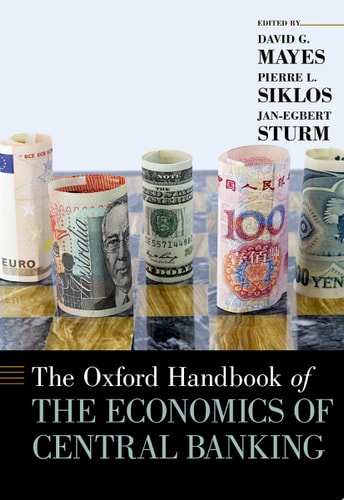
The Oxford Handbook of the Economics of Central Banking
0
0
As an Amazon Associate and affiliate partner, Menrva Books earns from qualifying purchases. Learn more
Author Description
The economic influence of central banks has received ever more attention given their centrality during the financial crises that led to the Great Recession, strains in the European Union, and the challenges to the euro. The Oxford Handbook of the Economics of Central Banking reflects the state of the art in the theory and practice and covers a wide range of topics that will provide insight to students, scholars, and practitioners. As an up to date reference of the current and potential challenges faced by central banks in the conduct of monetary policy and in the search for the maintenance of financial system stability, this Oxford Handbook covers a wide range of essential issues. The first section provides insights into central bank governance, the differing degrees of central bank independence, and the internal dynamics of their decision making. The next section focuses on questions of whether central banks can ameliorate fiscal burdens, various strategies to affect monetary policy, and how the global financial crisis affected the relationship between the traditional focus on inflation targeting and unconventional policy instruments such as quantitative easing (QE), foreign exchange market interventions, negative interest rates, and forward guidance. The next two sections turn to central bank communications and management of expectations and then mechanisms of policy transmission. The fifth part explores the challenges of recent developments in the economy and debates about the roles central banks should play, focusing on micro- and macro-prudential arguments. The implications of recent developments for policy modeling are covered in the last section. The breadth and depth enhances understanding of the challenges and opportunities facing central banks.
Menrva's Summary
THE THESIS
This volume investigates the evolving theoretical and practical frameworks governing central banks in the wake of global financial instability. The editors, Jan-Egbert Sturm, David G. Mayes, and Pierre L. Siklos, compile contributions from leading scholars to analyze how central banks navigate monetary policy, financial stability, and governance in a post-crisis economic landscape. The text provides a comprehensive synthesis of current academic debates and institutional practices regarding the mandate and operational limits of central banking authorities.
THE SCOPE MAP
What You Will Find
- Analysis of central bank governance and decision-making dynamics
- Examination of unconventional monetary policy tools including quantitative easing and negative interest rates
- Evaluation of communication strategies and expectation management
- Discussion of micro- and macro-prudential regulatory frameworks
Scope Limits
- Does not provide specific investment advice or real-time market forecasting
- Focuses primarily on institutional and theoretical frameworks rather than historical narratives of individual banking institutions
THE AUTHORITY PERSPECTIVE
Experts identify this work as a comprehensive reference for academics and practitioners seeking to understand the complexities of modern monetary policy. Readers frequently note the academic density of the prose, which is intended for those with a background in economic theory and policy analysis.
Page Count:
656
Publication Date:
2019-01-01
Publisher:
Oxford University Press
ISBN-10:
0190626208
ISBN-13:
9780190626204
Economics
Finance
Reference
Macroeconomics
Community Tags
Other Editions(2)
Similar Books








Reader Comments
Share Your Thoughts
No comments yet. Be the first to share your thoughts!