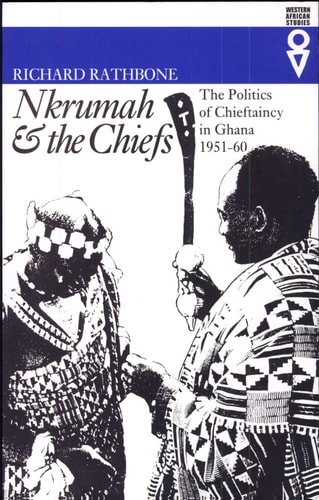
Nkrumah & the Chiefs: The Politics of Chieftaincy in Ghana, 1951-60
0
0
As an Amazon Associate and affiliate partner, Menrva Books earns from qualifying purchases. Learn more
Author Description
Kwame Nkrumah, who won independence for Ghana in 1957, was the first African statesman to achieve world recognition. Nkrumah and his movement also brought about the end of independent chieftaincy--one of the most fundamental changes in the history of Ghana. Kwame Nkrumah's Convention Peoples' Party was committed not only to the rapid termination of British colonial rule but also to the elimination of chiefly power. This book is an account of Kwame Nkrumah and his government's long struggle to wrest administrative control of the Ghanaian countryside from the chiefs. Based largely upon previously unstudied documentation in Ghana, this study charts the government's frustrated attempts to democratize local government and the long and bitter campaigns mounted by many southern chiefs to resist their political marginalization. Between 1951 and the creation of the First Republic in 1960, Ghanaian governments sought to discard the chiefly principle in local government, then to weaken chieftaincy by attrition and eventually, by altering the legal basis of chieftaincy, to incorporate and control a considerably altered chieftaincy. The book demonstrates that chieftaincy was consciously and systematically reconstructed in the decade of the 1950s with implications which can still be felt in modern Ghana.
Menrva's Summary
THE THESIS
This book investigates the complex political struggle between Kwame Nkrumah's government and traditional chiefs in Ghana during the pivotal decade of the 1950s, focusing on the systematic efforts to dismantle and reconstruct the institution of chieftaincy. Richard Rathbone, a historian specializing in African history, draws upon extensive, previously unstudied documentation from Ghana to detail the Convention Peoples' Party's commitment to both independence from colonial rule and the elimination of chiefly power. The study meticulously charts the government's attempts to democratize local administration and the determined resistance mounted by southern chiefs facing political marginalization. It demonstrates how, between 1951 and 1960, Ghanaian governments strategically altered the legal basis of chieftaincy and incorporated it under state control, fundamentally reshaping its role and implications for modern Ghana.
THE SCOPE MAP
- The political strategies employed by Kwame Nkrumah's government to undermine traditional chiefly authority.
- The resistance movements and campaigns organized by southern Ghanaian chiefs against political marginalization.
- Analysis of previously unstudied documentation from Ghana concerning local government reform.
- The legal and administrative changes implemented to weaken and control chieftaincy.
- The historical context of Ghana's transition from colonial rule to the First Republic.
- The long-term implications of the reconstructed chieftaincy in contemporary Ghana.
THE AUTHORITY PERSPECTIVE
This historical analysis is recognized for its deep dive into the political machinations surrounding chieftaincy in Ghana during the 1950s. Rathbone's meticulous research, utilizing previously inaccessible archives, provides a detailed account of the power struggle between the newly independent government and traditional leaders. The book is valued for its nuanced portrayal of both the government's reformist agenda and the chiefs' determined efforts to maintain their influence, offering critical insights into the foundational period of modern Ghana.
Page Count:
176
Publication Date:
2000-01-01
Publisher:
Ohio State University Press
ISBN-10:
0821413066
ISBN-13:
9780821413067
History
Politics
Non-Fiction
Community Tags
Similar Books