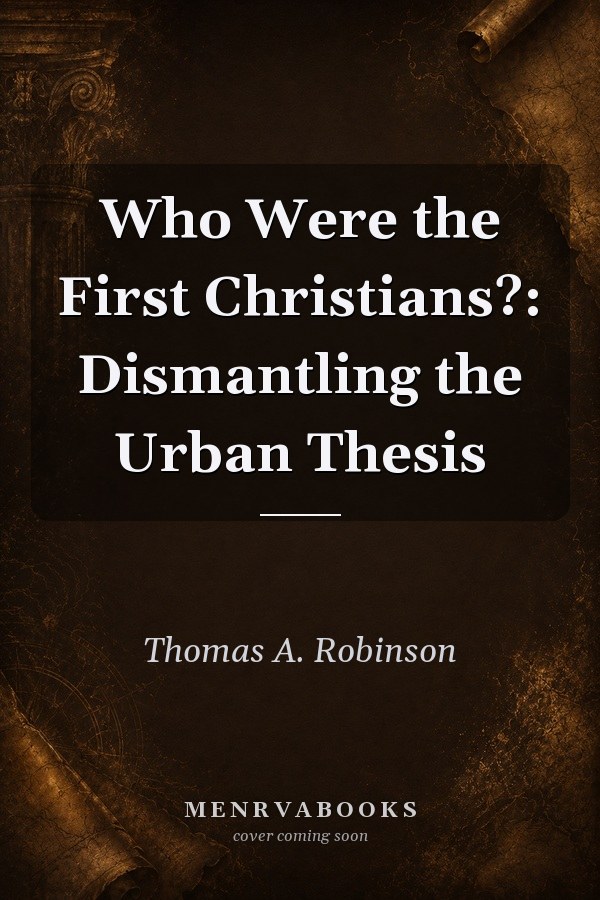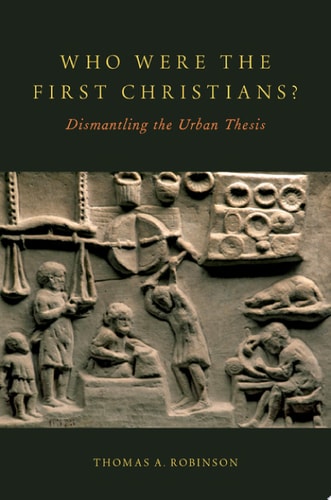
Who Were the First Christians?
0
0
As an Amazon Associate and affiliate partner, Menrva Books earns from qualifying purchases. Learn more
Author Description
It Has Been Widely Assumed That There Were 6 Million Christians (or 10% Of The Population Of The Roman Empire) By Around The Year 300. The Largely-unexamined Consensus View Is Also That Christianity Was An Urban Movement Until The Conversion Of Emperor Constantine. On Close Examination, It Appears That These Two Popular Views Would Nearly Saturate Every Urban Area Of The Entire Roman Empire With Christians, Leaving No Room For Jews Or Pagans. In Who Were The First Christians?, Thomas Robinson Shows That Scenario Simply Does Not Work. But Where Does The Solution Lie? Were There Many Fewer Christians In The Roman World Than We Have Thought? Was The Roman World Much More Urbanized? Or, Is The Urban Thesis Defective, So That The Neglected Countryside Must Now Be Considered In Any Reconstruction Of Early Christian Growth? Further, What Was The Makeup Of The Typical Christian Congregation? Was It A Lower-class Movement? Or Was It A Movement Of The Upwardly Mobile Middle-class? Arguing That More Attention Needs To Be Given To The Countryside And To The Considerable Contingent Of The Marginal And The Rustic Within Urban Populations, This Revisionist Work Argues Persuasively That The Urban Thesis Should Be Dismantled Or Profoundly Revised And The Growth And The Complexion Of The Early Christian Movement Seen In A Substantially Different Light.
Menrva's Summary
THE THESIS
This book investigates the demographic and sociological accuracy of the prevailing consensus regarding the size, urban concentration, and social status of the early Christian movement in the Roman Empire. Thomas A. Robinson, a scholar of early Christianity, utilizes historical data and demographic modeling to challenge the long-held assumption that Christians comprised 10% of the Roman population by 300 AD. He argues that the traditional 'urban thesis' is mathematically and historically inconsistent with the realities of the ancient world, proposing instead that the movement was more rural and socially diverse than previously acknowledged.
THE SCOPE MAP
What You Will Find
- Demographic analysis of the Roman Empire's population density and urbanization rates.
- A critical evaluation of the 'urban thesis' regarding early Christian growth.
- Sociological profiles of early Christian congregations and their social class composition.
Scope Limits
- The book does not provide a comprehensive theological history of the early church.
- It does not attempt to map every individual Christian community but focuses on structural and demographic trends.
THE AUTHORITY PERSPECTIVE
Scholars and historians frequently cite this work as a necessary corrective to unexamined demographic assumptions in early church studies. Readers often note the academic density of the prose, which requires a foundational understanding of Roman history to fully appreciate the author's methodology.
Page Count:
320
Publication Date:
2016-01-01
Publisher:
Oxford University Press
ISBN-10:
0190620552
ISBN-13:
9780190620554
Religion
History
Sociology of Religion
Roman Empire
Church History
Christianity
Community Tags
Similar Books