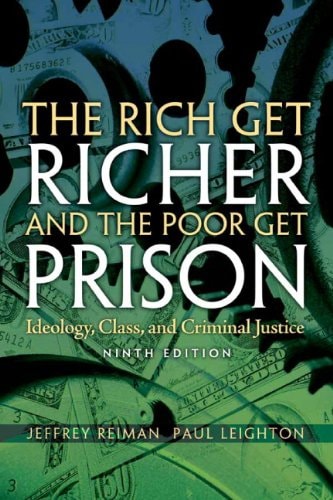
The Rich Get Richer and the Poor Get Prison: Ideology, Class, and Criminal Justice
0
0
As an Amazon Associate and affiliate partner, Menrva Books earns from qualifying purchases. Learn more
Author Description
This best-selling text examines the premise that the criminal justice system is biased against the poor from start to finish, from the definition of what constitutes a crime through the process of arrest, trial, and sentencing.Also, this text discusses how this bias is accompanied with a general refusal to remedy the causes of crime—poverty, lack of education, and discrimination.The author argues that actions of well-off people, such as their refusal to make workplaces safe, refusal to curtail deadly pollution, promotion of unnecessary surgery, and prescriptions for unnecessary drugs, cause occupational and environmental hazards to innocent members of the public and produce just as much death, destruction, and financial loss as so-called crimes of the poor. However, these acts of the well-off are rarely treated as crimes, and when they are, they are never treated as severely as crimes of the poor.NEW: This text now has a companion 25 article reader: The Rich get Richer and the Poor get Prison: A Reader (ISBN: 0-205-68842-X). Visit this book's website for a full table of contents.
Menrva's Summary
THE THESIS
Does the American criminal justice system function as a neutral arbiter of justice, or is it fundamentally structured to protect the interests of the wealthy while criminalizing the poor? Jeffrey Reiman and Paul Leighton utilize extensive sociological data and legal analysis to argue that the system is biased from inception to sentencing. They contend that the definition of crime itself ignores the lethal consequences of corporate negligence and environmental hazards, focusing instead on street-level offenses to maintain social control and class hierarchy.
THE SCOPE MAP
What You Will Find
- Analysis of the 'Pyrrhic defeat' theory regarding the failure to reduce crime.
- Comparative examination of street crime versus white-collar and corporate crime.
- Evaluation of systemic biases in policing, prosecution, and sentencing practices.
- Discussion on the socio-economic roots of crime, including poverty and educational inequality.
THE AUTHORITY PERSPECTIVE
This text is widely regarded as a foundational work in critical criminology, frequently utilized in academic settings to challenge conventional understandings of law and order. Its rigorous focus on the intersection of class, ideology, and institutional policy provides a dense, analytical framework for students and researchers examining systemic inequality.
Page Count:
288
Publication Date:
2009-08-08
Publisher:
Pearson
ISBN-10:
020568842X
ISBN-13:
9780205688425
United States
Administration of Justice
Sociology
Criminology
Social Classes
Law
Community Tags
Similar Books