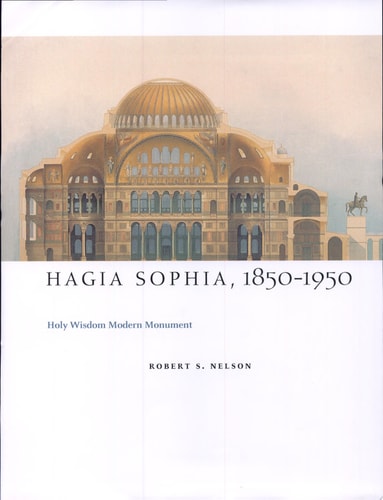
Hagia Sophia, 1850-1950: Holy Wisdom, Modern Monument
0
0
As an Amazon Associate and affiliate partner, Menrva Books earns from qualifying purchases. Learn more
Author Description
Hagia Sophia, the Church of Holy Wisdom, sits majestically atop the plateau that commands the straits separating Europe and Asia. Located near the acropolis of the ancient city of Byzantium, this unparalleled structure has enjoyed an extensive and colorful history, as it has successively been transformed into a cathedral, mosque, monument, and museum. In Hagia Sophia, 1850-1950, Robert S. Nelson explores its many lives. Built from 532 to 537 as the Cathedral of Constantinople, Hagia Sophia was little studied and seldom recognized as a great monument of world art until the nineteenth century, and Nelson examines the causes and consequences of the building's newly elevated status during that time. He chronicles the grand dome's modern history through a vibrant cast of characters—emperors, sultans, critics, poets, archaeologists, architects, philanthropists, and religious congregations—some of whom spent years studying it, others never visiting the building. But as Nelson shows, they all had a hand in the recreation of Hagia Sophia as a modern architectural icon. By many means and for its own purposes, the West has conceptually transformed Hagia Sophia into the international symbol that it is today. While other books have covered the architectural history of the structure, this is the first study to address its status as a modern monument. With his narrative of the building's rebirth, Nelson captures its importance for the diverse communities that shape and find meaning in Hagia Sophia. His book will resonate with cultural, architectural, and art historians as well as with those seeking to acquaint themselves with the modern life of an inspired and inspiring building.
Menrva's Summary
THE THESIS
The book investigates the transformation of the Hagia Sophia from a historical structure into a modern architectural icon between 1850 and 1950. Robert S. Nelson, an art historian, examines the period when the Hagia Sophia, previously a cathedral and mosque, began to be recognized as a significant monument of world art. The study details how Western perspectives and various historical figures, including emperors, sultans, critics, and architects, contributed to its elevated status. Nelson's work explores the diverse communities and their roles in shaping the building's modern identity and its perception as an international symbol.
THE SCOPE MAP
- The re-evaluation of Hagia Sophia's status as a world art monument in the 19th century.
- The historical figures and their roles in shaping the building's modern perception.
- The transformation of Hagia Sophia into a modern architectural icon.
- The influence of the West in conceptualizing Hagia Sophia as an international symbol.
- The building's importance for diverse communities and their meaning-making.
- A focus on the modern history of the structure, distinct from purely architectural studies.
THE AUTHORITY PERSPECTIVE
This book is positioned as a significant contribution to the study of Hagia Sophia, being the first to specifically address its status as a modern monument. The author's exploration of its transformation between 1850 and 1950, through the lens of various historical figures and Western influence, is noted as a key aspect. It is expected to resonate with cultural, architectural, and art historians, as well as general readers interested in the building's modern life. The work aims to capture the building's importance for the diverse communities that shape and find meaning in it.
Page Count:
278
Publication Date:
2004-07-14
Publisher:
University of Chicago Press
ISBN-10:
0226571718
ISBN-13:
9780226571713
Architecture
History
Non-Fiction
Cultural History
Art History
Community Tags
Similar Books














