A Rock Between Hard Places: Afghanistan as an Arena of Regional Insecurity
0
0
As an Amazon Associate and affiliate partner, Menrva Books earns from qualifying purchases. Learn more
Author Description
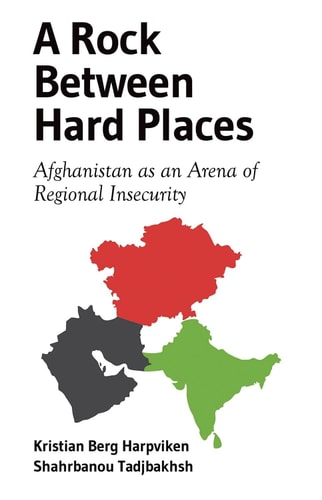
What has driven neighbouring states to intervene in the Afghan conflict? This book challenges mainstream analyses which place Afghanistan at the centre - the so-called 'heart' - of a large pan-Asian region whose fate is predicated on Afghan stability. Instead Harpviken and Tadjbakhsh situate Afghanistan on the margins of three regional security complexes - those of South Asia, Central Asia, and the Persian Gulf - each characterised by deep security rivalries, which, in turn, informs their engagement in Afghanistan. Within Central Asia, security cooperation is hampered by competition for regional supremacy and great power support, a dynamic reflected in these states' half-hearted role in Afghanistan. In the Persian Gulf, Iran and Saudi Arabia fight for economic and political influence, mirrored in their Afghan engagements; while long-standing Indo-Pakistani rivalries are perennially played out in Afghanistan.Based on a careful reading of the recent political and economic history of the region, and of Great Power rivalry beyond it, the authors explain why efforts to build a comprehensive Afghanistan-centric regional security order have failed, and suggest what might be done to reset inter-state relations.
Menrva's Summary
THE THESIS
This book investigates why neighboring states intervene in the Afghan conflict and why previous attempts to establish an Afghanistan-centric regional security order have failed. The authors, Kristian Berg Harpviken and Shahrbanou Tadjbakhsh, utilize a regional security complex framework to argue that Afghanistan is not the central hub of a pan-Asian region, but rather a marginal territory influenced by the competing security dynamics of South Asia, Central Asia, and the Persian Gulf. By analyzing the political and economic history of these surrounding regions, they demonstrate how external rivalries—such as those between India and Pakistan or Iran and Saudi Arabia—inevitably dictate the nature of foreign engagement within Afghan borders.
THE SCOPE MAP
What You Will Find
- Analysis of regional security complexes in South Asia, Central Asia, and the Persian Gulf.
- Examination of how great power rivalries influence local state behavior.
- Historical and economic context regarding inter-state relations surrounding Afghanistan.
- Proposed policy frameworks for resetting regional diplomatic relations.
Scope Limits
- The text does not provide a comprehensive military history of the Afghan war itself.
- It does not focus on internal Afghan tribal or social dynamics, prioritizing external state actors instead.
THE AUTHORITY PERSPECTIVE
Experts in international relations identify this work as a significant contribution to the study of regional security complexes and the geopolitical constraints facing Afghanistan. Readers frequently note the academic density of the prose, which is well-suited for scholars and policy analysts seeking a structural understanding of regional instability.
Page Count:
224
Publication Date:
2016-09-01
Publisher:
Oxford University Press
ISBN-10:
0190627239
ISBN-13:
9780190627232
Geopolitics
Security Studies
Middle Eastern
Asian Studies
Politics & Government
International relations
Community Tags
Similar Books