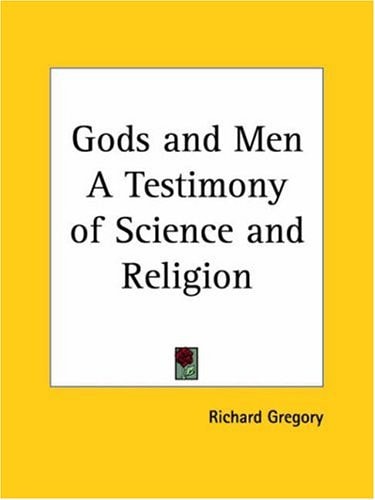
Gods and Men: A Testimony of Science and Religion
0
0
As an Amazon Associate and affiliate partner, Menrva Books earns from qualifying purchases. Learn more
Author Description
1949. An examination of the relationship between science and religion, focusing on our understanding of the earth's place in the universe and on the question of the existence of God. "Civilization cannot be defined in terms of religion or without them, but by the wisdom with which knowledge is used to promote general 'well-being' and 'well-doing.' This makes works a measure of the significance of faiths, reason the breaker of superstitious images, and world religion the pursuit and comprehension of knowledge in the spirit of exalted humanism."
Menrva's Summary
THE THESIS
This work examines the intricate relationship between scientific understanding and religious belief, particularly concerning humanity's cosmic perspective and the theological question of divine existence. Richard E. Gregory's 1949 text posits that true civilization is measured not by faith alone, but by the wise application of knowledge for collective well-being and ethical conduct. The book argues that reason serves to dismantle superstition, and that world religion, at its best, represents the pursuit of knowledge through a lens of exalted humanism.
THE SCOPE MAP
- Exploration of the historical and philosophical connections between scientific discovery and religious doctrine.
- Analysis of how evolving scientific models of the universe have impacted theological thought.
- Discussion on the definition of civilization, emphasizing the role of knowledge application over mere belief.
- The function of reason in dispelling superstition and its relationship to faith.
- An argument for a humanistic approach to understanding world religions through the pursuit of knowledge.
THE AUTHORITY PERSPECTIVE
This book, originally published in 1949, offers a philosophical inquiry into the perceived dichotomy between science and religion. The text frames civilization's progress through the lens of applied knowledge and reason, suggesting a path toward a more humanistic understanding of faith. Its enduring relevance lies in its examination of timeless questions regarding humanity's place in the cosmos and the nature of belief.
Page Count:
232
Publication Date:
2003-03-01
Publisher:
Kessinger Pub Co
ISBN-10:
0766136191
ISBN-13:
9780766136199
Non-Fiction
Religion
Philosophy
Science
Community Tags
Similar Books