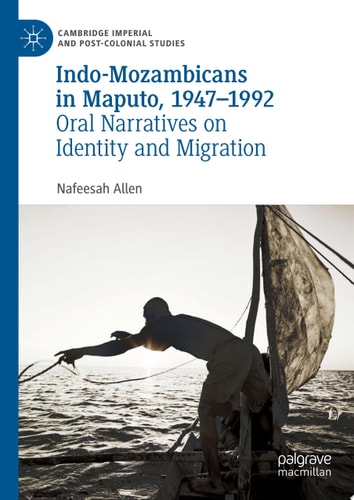
Indo-Mozambicans in Maputo, 1947-1992
0
0
As an Amazon Associate and affiliate partner, Menrva Books earns from qualifying purchases. Learn more
Author Description
This book explores the experiences of ‘Indo-Mozambicans,’ citizens and residents of Mozambique who can trace their origins to the Indian subcontinent, a region affected by competing colonialisms during the twentieth century. Drawing from ethnographic interviews, the author illustrates why migration developed as both an identity marker and a survival tool for Indo-Mozambicans living in Maputo, in response to the series of independence movements and prolonged period of geo-political uncertainty that extended from 1947 to 1992. A unique examination of post-colonialism, the book argues that four pivotal moments in history forced migratory patterns and ethnic identity formations to emerge among Indo-Mozambicans, namely, the end of the British empire in India and the subsequent partition of India and Pakistan in 1947; the end of the Portuguese empire in India, with the annexation of Goa, Daman and Diu in 1961; the independence of Mozambique from Portugal in 1975; and the civil war of Mozambique from 1977 to 1992. Framing these historical markers as trigger points for shifts in migration and identity formation, this book demonstrates the layered experiences of people subject to Portuguese colonialism and highlights the important perspective of those ‘left behind’ in migration studies.
Menrva's Summary
THE THESIS
This book investigates the complex historical and social experiences of Indo-Mozambicans in Maputo between 1947 and 1992. Drawing on ethnographic interviews, the author details how migration became both a defining aspect of identity and a crucial survival mechanism for this community. The narrative unfolds against the backdrop of significant geopolitical shifts, including decolonization and civil conflict, which profoundly shaped the lives of Indo-Mozambicans. The book examines four pivotal historical moments that triggered migratory patterns and ethnic identity formations, offering a nuanced perspective on the layered experiences of those affected by colonialism and migration.
THE SCOPE MAP
- Exploration of the 'Indo-Mozambican' identity, tracing origins to the Indian subcontinent.
- Analysis of migration as both an identity marker and a survival tool.
- Detailed examination of the period from 1947 to 1992, encompassing decolonization and civil war.
- Focus on ethnographic interviews as a primary research method.
- Identification of four key historical trigger points: Indian Partition (1947), annexation of Goa (1961), Mozambican Independence (1975), and Mozambican Civil War (1977-1992).
- Discussion of the impact of competing colonialisms on the community.
- Contribution to post-colonial studies by highlighting the perspective of those 'left behind' in migration studies.
THE AUTHORITY PERSPECTIVE
The book is framed as a unique examination of post-colonialism, specifically focusing on the often-overlooked experiences of Indo-Mozambicans. Its methodology, relying on ethnographic interviews, suggests a deeply personal and ground-level perspective on historical events. The author's argument centers on how specific historical junctures compelled shifts in migration and identity, offering a detailed look at the layered impacts of Portuguese colonialism. This work aims to highlight the nuanced experiences of a diasporic community navigating significant political and social transformations.
Page Count:
245
Publication Date:
2022-11-01
Publisher:
Springer Nature
ISBN-10:
3031088263
ISBN-13:
9783031088261
Non-Fiction
History
African history
Ethnography
Migration Studies
Sociology
Community Tags
Similar Books