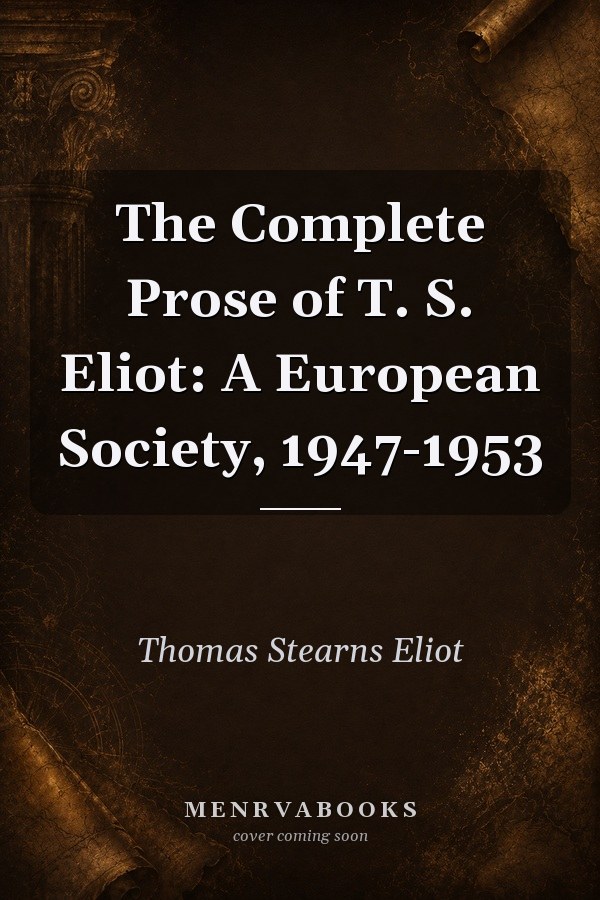
The Complete Prose of T. S. Eliot: A European Society, 1947-1953
0
0
As an Amazon Associate and affiliate partner, Menrva Books earns from qualifying purchases. Learn more
Author Description
The postwar years of this volume represent one of the richest and most rewarding periods of Eliot's career. Following receipt of the Nobel Prize for Literature in 1948, he was in constant demand to lecture, broadcast, contribute to periodicals, and receive honorary degrees and recognition from numerous European, American, and British universities and societies. These activities produced a great variety of unpublished, uncollected, and unrecorded addresses, speeches, and tributes, together with ten major literary essays that have become part of Eliot's permanent canon, from "Milton II" to "The Three Voices of Poetry." A film version of Murder in the Cathedral and the publication and production of two new plays, The Cocktail Party and The Confidential Clerk, generated new essays on the relation of poetry, drama, and the theater, leading to the canonical "Poetry and Drama." Of central concern in the volume is the relation of religion, education, and culture, and the responsibility of the man of letters for reconstructing that relation after the devastations of war, a concern developed in Notes towards the Definition of Culture and expanded in the previously unpublished "Die Idee einer europäischen Gesellschaft" [The Idea of a European Society].
Menrva's Summary
THE THESIS
This volume collects the extensive prose writings of T. S. Eliot from a pivotal period following World War II, a time of significant personal recognition and intellectual engagement. The years 1947-1953 mark Eliot's receipt of the Nobel Prize and his subsequent global demand as a lecturer and essayist, producing a wealth of material including speeches, tributes, and major literary essays. This collection delves into his reflections on the relationship between poetry, drama, and theater, particularly in light of his new plays, and explores his profound concern with the reconstruction of culture, religion, and education in a post-war Europe. The volume also includes previously unpublished works, such as his thoughts on the idea of a European society, offering a comprehensive view of his intellectual output during this rich period.**
THE SCOPE MAP
- Major literary essays including 'Milton II' and 'The Three Voices of Poetry'.
- Essays on the relationship between poetry, drama, and theater, such as 'Poetry and Drama'.
- Previously unpublished address 'Die Idee einer europäischen Gesellschaft' (The Idea of a European Society).
- Reflections on the role of religion, education, and culture in post-war reconstruction.
- Speeches, tributes, and addresses delivered during Eliot's extensive lecturing engagements.
- Material related to the film version of 'Murder in the Cathedral' and new plays 'The Cocktail Party' and 'The Confidential Clerk'.
THE AUTHORITY PERSPECTIVE
This collection is presented as a scholarly critical edition, focusing on a highly productive period in T. S. Eliot's career following his Nobel Prize. The inclusion of previously unpublished and uncollected works suggests a significant contribution to understanding Eliot's engagement with post-war European intellectual life and his evolving views on culture and the arts. The editorial apparatus, indicated by the 'Critical Edition' designation and the editors' names, points to a text aimed at scholars and serious students of literature and history. The material covered, from literary criticism to cultural commentary, highlights Eliot's broad influence and his role in shaping post-war thought.
Page Count:
908
Publication Date:
2018-01-01
Publisher:
Faber & Faber
ISBN-10:
1421418940
ISBN-13:
9781421418940
Non-Fiction
History
European History
Essays
Literary Criticism
Community Tags
Similar Books