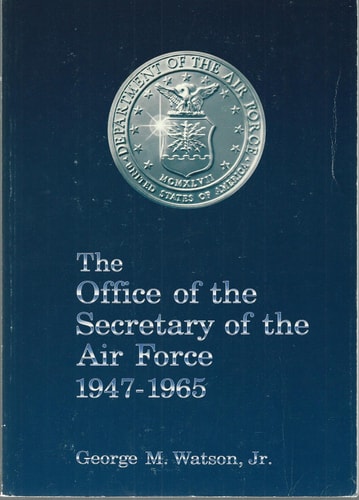
The Office of the Secretary of the Air Force, 1947-1965
0
0
As an Amazon Associate and affiliate partner, Menrva Books earns from qualifying purchases. Learn more
Author Description
If power in Washington is often thought of as a zero-sum game, success is best achieved by creating "win-win" propositions. The Secretary of the Air Force, placed at the nexus of several power centers and responsible for fashioning a consensus, reports to the Secretary of Defense, deals with various deputy secretaries as peers, and interacts with the Air Force Chief of Staff, who supervises the service. The Secretary has real but circumscribed influence, yet must, to be effective, move individuals and agencies, with little more than limited or indirect authority over them.This work traces the history of the Office of the Secretary of the Air Force from its formation in the 1920s (as the Office of the Assistant Secretary of War for Air) through World War II, under Robert A. Lovett. It concentrates on the period from 1947, when the Air Force became independent of the Army, to 1965, when the United States became involved in the Vietnam War. During this time several laws significantly reshaped the U. S. military establishment: the National Security Act of 1947, its amendments of 1949, Reorganization Plan No 6 of 1953, and the Department of Defense Reorganization Act of 1958. These laws gradually strengthened the Department of Defense and firmly established civilian control over the military services.Author George Watson details how these laws affected the functioning of the first seven Secretaries of the Air Force, from W. Stuart Symington to Eugene M. Zuckert. The Air Force and its Secretaries struggled over autonomy, roles, and missions; fought the Korean War and the Cold War; procured advanced aircraft, missiles, and other weapons; and wrestled with many issues involving budgets, force size and structure, racial integration, morale, and congressional and public relations.The Secretaries of the Air Force have each brought unique leadership styles to office.
Menrva's Summary
THE THESIS
The Office of the Secretary of the Air Force navigates complex power dynamics to maintain civilian control and service autonomy. This work examines the historical evolution of the Office of the Secretary of the Air Force from its early roots to its establishment as an independent entity in 1947. It focuses on the critical period between 1947 and 1965, detailing how landmark legislation like the National Security Act of 1947 and the Department of Defense Reorganization Act of 1958 reshaped the military establishment and solidified civilian oversight. The book analyzes the challenges faced by the first seven Secretaries, including struggles for autonomy, participation in major conflicts like the Korean and Cold Wars, and the procurement of advanced weaponry.
THE SCOPE MAP
- The historical development of the Office of the Secretary of the Air Force from the 1920s to 1965.
- Analysis of key legislative acts that strengthened the Department of Defense and civilian control.
- Detailed accounts of the challenges and successes of the first seven Secretaries of the Air Force.
- Exploration of the Air Force's role in the Korean War and the Cold War.
- Discussion of major issues including aircraft and missile procurement, budgets, force structure, and public relations.
THE AUTHORITY PERSPECTIVE
This comprehensive historical account details the intricate workings and evolving authority of the Office of the Secretary of the Air Force during a pivotal era of American military development. The book meticulously traces the impact of significant legislative reforms on the balance of power between civilian leadership and military services. It offers insights into the strategic decisions and internal struggles that defined the early decades of the independent Air Force. The work provides a thorough examination of the leadership styles and operational challenges faced by the Secretaries tasked with guiding the service through major global conflicts and technological advancements.
Page Count:
390
Publication Date:
1993-01-01
Publisher:
Center for Air Force History : For sale by the Supt. of Docs., U.S. G.P.O.
ISBN-10:
0912799781
ISBN-13:
9780912799780
History
Non-Fiction
Politics
Military History
Government
Community Tags
Similar Books