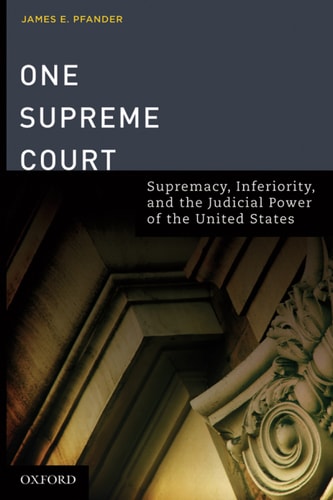
One Supreme Court: Supremacy, Inferiority, and the Judicial Department of the United States
0
0
As an Amazon Associate and affiliate partner, Menrva Books earns from qualifying purchases. Learn more
Author Description
Despite over two hundred years of experience with constitutional government, much remains unclear about the power of the political branches to curtail or re-define the judicial power of the United States. Uncertainty persists about the basis on which state courts and federal agencies may hear federal claims and the degree to which federal courts must review their decisions. Scholars approach these questions from a range of vantage points and have arrived at widely varying conclusions about the relationship between congressional and judicial power. Deploying familiar forms of legal analysis, and relying upon a new account of the Court's supremacy in relation to lower courts and tribunals, James Pfander advances a departmental conception of the judiciary. He argues that Congress can enlist the state courts, lower federal courts, and administrative agencies to hear federal claims in the first instance, but all of these tribunals must operate within a hierarchical framework over which the "one supreme Court" identified in the Constitution exercises ultimate supervisory authority. In offering the first general account of the Court as department head, Pfander takes up such important debates in the federal courts' literature as Congress's power to strip the federal courts of jurisdiction to review state court decisions, its authority to assign decision-making authority to state courts and non-Article III tribunals, its control over the doctrine of vertical stare decisis, and its ability to craft rules of practice for the federal system.
Menrva's Summary
THE THESIS
This work investigates the constitutional parameters of the United States judiciary, specifically addressing the extent of congressional authority to define or limit judicial power. James E. Pfander, a professor of law, utilizes historical constitutional analysis and a departmental framework to argue that while Congress may delegate initial adjudication to various tribunals, the Supreme Court maintains ultimate supervisory authority over all federal claims. This departmental conception posits that the "one supreme Court" functions as the head of a unified judicial department, ensuring hierarchical consistency across state courts, lower federal courts, and administrative agencies.
THE SCOPE MAP
What You Will Find
- A historical and legal analysis of Article III of the U.S. Constitution.
- A framework for understanding the relationship between Congress and the judicial branch.
- Examination of vertical stare decisis and jurisdictional stripping.
Scope Limits
- The text does not provide a comprehensive history of every Supreme Court decision regarding jurisdiction.
- It does not focus on the political motivations of individual justices or specific historical eras outside of constitutional interpretation.
THE AUTHORITY PERSPECTIVE
Legal scholars and practitioners recognize this text as a significant contribution to the literature on federal courts and judicial hierarchy. Experts frequently note the academic density of the prose, characterizing it as a rigorous examination of the structural design of the American legal system.
Page Count:
328
Publication Date:
2009-01-01
Publisher:
Oxford University Press
ISBN-10:
0190623551
ISBN-13:
9780190623555
Constitutions
Government
Law
Constitutional Law
Executive power
Courts
Judicial History
Professional Career & Trade
United States
Community Tags
Similar Books