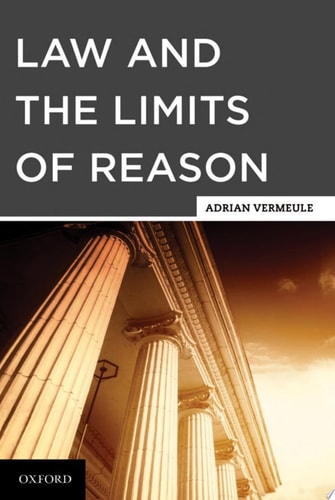
Law and the Limits of Reason
0
0
As an Amazon Associate and affiliate partner, Menrva Books earns from qualifying purchases. Learn more
Author Description
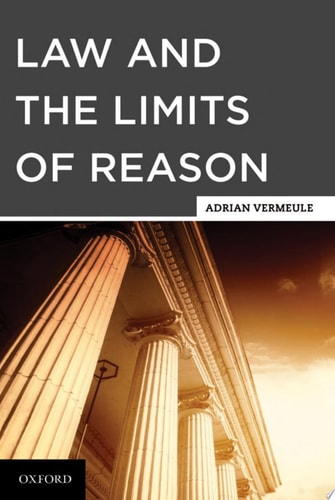
Human reason is limited. What are the consequences of this fact for the contested lawmaking claims between courts, legislatures and the executive branch? In light of the limits of reason, how should legal institutions be designed? In Law and the Limits of Reason, Adrian Vermeule criticizes the view that the limits of reason counsel in favor of judicial lawmaking in the style of the common law. He argues that there is no logical connection between the limits of reason, on the one hand, and the superiority of common law or of judge-made constitutional law on the other. The relatively small number of judges on relevant courts, their limited informational base and generalist rather than specialized skills, ensure that judicial reason is itself sharply limited and that the argument to judicial lawmaking from the limits of reason outruns the logical, causal, and evidentiary support.Instead, Adrian Vermeule proposes and defends a "codified constitution" - a regime in which legislatures have the primary authority to develop constitutional law over time, through statutes and constitutional amendments. Precisely because of the limits of human reason, large modern legislatures, with their numerous membership, complex internal structures for processing information and their abundant informational resources, are the most effective lawmaking institutions. Law and the Limits of Reason, now in paperback, serves as a thought-provoking companion to any constitutional law course of study.
Menrva's Summary
THE THESIS
This work investigates how the inherent limitations of human reason should dictate the structural design and authority of legal institutions, specifically regarding the balance of power between courts and legislatures. Adrian Vermeule, a legal scholar, challenges the prevailing assumption that judicial lawmaking is a superior response to the constraints of human cognition. By analyzing the informational and structural capacities of different branches of government, he argues that the common law tradition lacks a logical basis for its perceived superiority in constitutional interpretation. Instead, he advocates for a codified constitution where legislatures, due to their superior information-processing capabilities, serve as the primary architects of constitutional law.
THE SCOPE MAP
What You Will Find
- A critique of judicial lawmaking and the common law tradition.
- An analysis of the institutional capacity of courts versus large modern legislatures.
- A defense of a codified constitution as a mechanism for constitutional development.
- An examination of the causal and evidentiary links between human cognitive limits and institutional design.
THE AUTHORITY PERSPECTIVE
Legal scholars and constitutional law students frequently cite this text for its rigorous challenge to traditional judicial supremacy. Experts highlight the book as a foundational contribution to the debate over institutional competence and the limits of legal reasoning in modern governance.
Page Count:
211
Publication Date:
2012-04-27
Publisher:
Oxford University Press
ISBN-10:
0199914095
ISBN-13:
9780199914098
Philosophy
United States
Professional Career & Trade
Law
Legal Theory
Constitutional Law