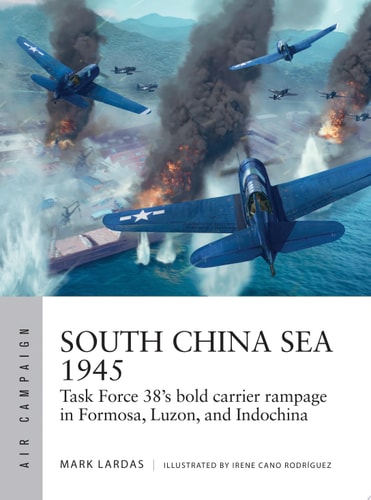
South China Sea 1945
0
0
As an Amazon Associate and affiliate partner, Menrva Books earns from qualifying purchases. Learn more
Author Description
A history of the US Navy's remarkable 1945 South China Sea raid against the Japanese, the first time in history that a carrier fleet dared to rampage through coastal waters. As 1945 opened, Japan was fighting defensively everywhere. As the Allies drew closer to the Home Islands, risks of Japanese air and sea attack on the US Navy carrier force increased. US forces wanted to take the island of Luzon which provided a base for Japanese aircraft from Formosa (Taiwan) and Indochina, and from where attacks could easily be devastating for the invasion fleet. US Naval Intelligence also believed Japanese battleships Ise and Hyuga were operating out of Cam Ranh Bay. A fast carrier sweep through the South China Sea was a potential answer with the bonus that it would strike the main nautical highway for cargo from Japan's conquests in Southeast Asia. Task Force 38 would spend the better part of two weeks marauding through the South China Sea during Operation Gratitude, a month-long sweep of the area, which launched air strikes into harbors in Indochina, the Chinese coast and Formosa, while targeting shipping in the high-traffic nautical highway. By the time the Task Force exited the South China Sea, over 300,000 tons of enemy shipping and dozens of Japanese warships had been sunk. With follow-up air strikes against Japanese harbors and airfields in Formosa and the Ryukyu Islands, the success of the sweep was unprecedented. Using detailed battlescenes, maps, bird's eye views, and diagrams of air strikes at Luzon, this intriguing account of Task Force 38's reign in the South China Sea proved that aircraft carriers could dominate the land-based air power of the fading Japanese. From the Korean War through to Vietnam, to the campaigns in Iraq, aircraft carriers could sail safely offshore, knowing their aircraft would prevail on both sea and land.
Menrva's Summary
THE THESIS
The US Navy's carrier fleet executed a daring raid into the South China Sea in 1945, challenging Japanese naval dominance in coastal waters for the first time in history. As World War II neared its end, Japan was on the defensive, but still capable of launching devastating attacks from bases in Indochina and Formosa. Task Force 38's mission was to neutralize these threats, secure a staging area for the invasion of Luzon, and potentially strike at Japanese battleships believed to be in Cam Ranh Bay. This sweep also aimed to disrupt Japan's vital shipping routes from Southeast Asia.
THE SCOPE MAP
- Detailed account of the US Navy's 1945 South China Sea raid, codenamed Operation Gratitude.
- Analysis of the strategic importance of Luzon and the threat posed by Japanese air and sea power.
- Examination of the risks involved in a carrier fleet operating in enemy coastal waters.
- Coverage of air strikes against targets in Indochina, China, Formosa, and the Ryukyu Islands.
- Details on the significant tonnage of enemy shipping and number of warships sunk.
- Discussion of how the raid demonstrated the dominance of aircraft carriers over land-based air power.
- Use of detailed battlescenes, maps, bird's eye views, and diagrams of air strikes.
THE AUTHORITY PERSPECTIVE
This historical account is likely to be appreciated by military history enthusiasts, particularly those interested in naval warfare and the Pacific theater of World War II. The detailed maps and battle diagrams suggest a work that prioritizes tactical and strategic analysis. The narrative focuses on the operational success of Task Force 38 and its implications for carrier warfare, indicating a scholarly approach to the subject matter. The book's conclusion likely emphasizes the long-term impact of this raid on naval aviation doctrine.
Page Count:
96
Publication Date:
2023-03-16
Publisher:
Bloomsbury UK
ISBN-10:
1472853105
ISBN-13:
9781472853103
Non-Fiction
History
Asian History
Military History
Naval history
Community Tags
Similar Books