
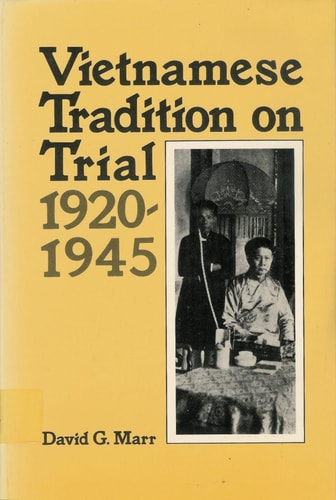
Vietnamese Tradition on Trial, 1920-1945
0
0
As an Amazon Associate and affiliate partner, Menrva Books earns from qualifying purchases. Learn more
Author Description
Despite the historical importance of the Vietnam War, we know very little about what the Vietnamese people thought and felt prior to the conflict. Americans have tended to treat Vietnam as an extension of their own hopes and fears, successes and failures, rather than addressing the Vietnamese record. In this volume, David Marr offers the first serious intellectual history of Vietnam, focusing on the period just prior to full-scale revolutionary upheaval and protracted military conflict. He argues that changes in political and social consciousness between 1920 and 1945 were a necessary precondition to the mass mobilization and people's war strategies employed subsequently against the French and the Americans. Thus he rejects the prevailing notion that Vietnamese success was primarily due to communist techniques of organization. However, Vietnamese Tradition on Trial goes beyond simply accounting for anyone's victory or defeat to an informed description of intellectual currents in general. Replying for his information on a previously ignored corpus of books, pamphlets, periodicals, and leaflets, the author isolates eight issues of central concern to twentieth-century Vietnamese. The new intelligentsia—indubitably the product of a peculiar French colonial milieu, yet never divorced from the Vietnamese past and always looking to a brilliant Vietnamese future—spearheaded every debate beginning ini 1925. After 1945, Vietnamese intellectuals either placed themselves under ruthless battlefield discipline or withdrew to private meditation. David Marr suggests that the new problems facing Vietnamese today make both of these approaches anachronistic. Whether the Vietnam Communist Party will allow citizens to subject received wisdom to critical debate, to formulate new explanations of reality, to test those explanations in practice, is the essential question lingering at the end of this study.
Menrva's Summary
THE THESIS
This book investigates the evolution of Vietnamese political and social consciousness between 1920 and 1945, arguing that these changes were crucial precursors to later revolutionary strategies. David G. Marr, a historian specializing in Vietnam, draws upon a wide array of previously overlooked Vietnamese-language materials, including books, pamphlets, periodicals, and leaflets, to reconstruct the intellectual landscape of the era. He posits that the intellectual currents of this period, spearheaded by a new intelligentsia shaped by French colonialism yet deeply connected to Vietnam's past and future, laid the groundwork for mass mobilization, challenging the notion that communist organizational techniques were the sole drivers of success. The study examines eight central issues that preoccupied Vietnamese thinkers during this transformative time.
THE SCOPE MAP
- An intellectual history of Vietnam focusing on the period 1920-1945.
- Analysis of the changes in political and social consciousness preceding revolutionary upheaval.
- Exploration of the role of a new intelligentsia shaped by French colonial influence.
- Examination of eight central issues debated by Vietnamese intellectuals.
- Rejection of the prevailing notion that Vietnamese success was solely due to communist organizational techniques.
- Discussion of the intellectual currents that informed mass mobilization and people's war strategies.
- Consideration of the anachronistic nature of post-1945 intellectual approaches in contemporary Vietnam.
THE AUTHORITY PERSPECTIVE
David Marr's work is recognized for providing the first comprehensive intellectual history of Vietnam during a critical pre-revolutionary period. The study is noted for its deep engagement with a wide range of Vietnamese-language sources, offering a nuanced perspective on the intellectual debates and shifts in consciousness that preceded the major conflicts of the 20th century. It challenges conventional explanations for Vietnamese success by highlighting the foundational role of intellectual and social changes. The book's analysis of the new intelligentsia and their engagement with both tradition and future aspirations offers significant insight into the period.
Page Count:
468
Publication Date:
1984-02-03
Publisher:
University of California Press
ISBN-10:
0520050819
ISBN-13:
9780520050815
Non-Fiction
History
Asian Studies
Intellectual History
Colonialism
Community Tags
Other Editions(3)

Similar Books




Reader Comments
Share Your Thoughts
No comments yet. Be the first to share your thoughts!