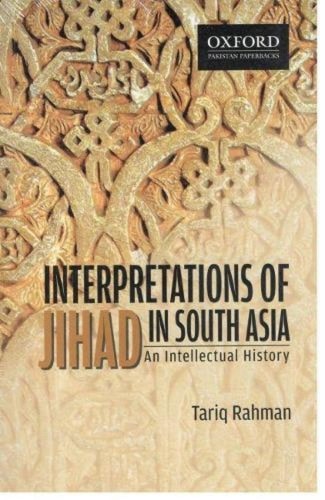
Interpretations of Jihad in South Asia: An Intellectual History
0
0
As an Amazon Associate and affiliate partner, Menrva Books earns from qualifying purchases. Learn more
Author Description
In the wake of radical Islamist terrorist attacks described as jihad worldwide and in South Asia, it is imperative that there should be a book-length study of this idea in this part of the world. The focus of the study is the idea of jihad with its changing interpretations mostly those available in exegetical literature of key figures in South Asia. The hermeneutic devices used to understand the meaning of the Qur'anic verses and the Prophetic traditions relating to jihad will be the focus of this study. The main thrust of the study is to understand how interpretations of jihad vary. It is seen as being both defensive and aggressive by traditionalists; only defensive and mainly about moral improvement by progressive Muslims; and being insurrectionist, aggressive, eternal and justifying violence against civilians by radical Islamists. One purpose of the book is to understand how the radical interpretation came to South Asia. The book also explains how theories about jihad are influenced by the political and social circumstances of the period and how these insights feed into practice legitimizing militant movements called jihad for that period. Rahman has investigated ideas of jihad in South Asia to a breadth and a depth rivalled by no other. He has produced arguments about how they have changed which all should note. In the process, he has produced a book of great value both to the scholar and to the policymaker. Francis Robinson, Professor of History of Islam in South Asia, Royal Holloway, University of London The degree of painstaking research and detail, which has gone into discussing the historical, linguistic, and intellectual aspects of jihad in South Asia comprises a praiseworthy addition to the understanding of the phenomenon of jihad (original in Urdu). Khalid Masood, former Professor at the International Islamic University, Islamabad and Chairman, Council of Islamic Ideology, Islamabad, Pakistan
Menrva's Summary
THE THESIS
This book investigates the intellectual history and evolving interpretations of the concept of jihad within South Asia, specifically examining how these interpretations have been shaped by political and social contexts. Dr. Tariq Rahman, a scholar of South Asian history and linguistics, employs a rigorous hermeneutic approach to analyze exegetical literature from key regional figures. By examining Qur'anic interpretations and Prophetic traditions, the author maps the shift from traditional defensive concepts to modern insurrectionist ideologies.
THE SCOPE MAP
What You Will Find
- Analysis of exegetical literature from influential South Asian Islamic scholars.
- Examination of hermeneutic devices used to interpret jihad in the Qur'an and Hadith.
- Comparative study of traditionalist, progressive, and radical Islamist perspectives.
- Historical contextualization of how political circumstances influence theological doctrine.
Scope Limits
- The study focuses primarily on South Asian intellectual history rather than a global survey of Islamic jurisprudence.
- It does not provide a comprehensive sociological survey of contemporary militant groups, focusing instead on the intellectual and textual foundations of their ideologies.
THE AUTHORITY PERSPECTIVE
Experts in the field of Islamic history recognize this work as a significant contribution to the understanding of regional theological shifts. Readers frequently note the academic density of the prose and the depth of the historical research provided by the author.
Page Count:
323
Publication Date:
2019-01-01
Publisher:
OUP
ISBN-10:
0190701838
ISBN-13:
9780190701833
History
Religion
Islam
Subjects
Intellectual History
Asian Studies
Community Tags
Similar Books