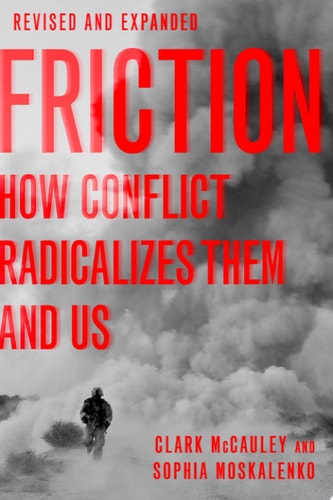
Friction: How Conflict Radicalizes Them and Us
0
0
As an Amazon Associate and affiliate partner, Menrva Books earns from qualifying purchases. Learn more
Author Description
Terrorism is an extreme form of radicalization. In this ground-breaking and important book, Clark McCauley and Sophia Moskalenko identify and outline twelve mechanisms of political radicalization that can move individuals, groups, and the masses to increased sympathy and support for political violence.Co-authored by two psychologists both acknowledged in their field as experts in radicalization and consultants to the Department of Homeland Security and other government agencies, Friction draws on wide-ranging case histories to show striking parallels between 1800s anti-czarist terrorism, 1970s anti-war terrorism, and 21st century jihadist terrorism. Altogether, the twelve mechanisms of political radicalization demonstrate how unexceptional people are moved to exceptional violence in the conflict between states and non-state challengers.In this revised and expanded edition, McCauley and Moskalenko use the twelve mechanisms to analyze recent cases of lone-wolf terrorists and illustrate how individuals can become radicalized to jihadist violence with group influence or organizational support. Additionally, in the context of the Islamic State's worldwide efforts to radicalize moderate Muslims for jihad, they advance a model that differentiates radicalization in opinion from radicalization in action, and suggest different strategies for countering these diverse forms of radicalization. As a result, the authors conclude that the same mechanisms are at work in radicalizing both terrorists and states targeted by terrorists, implying that these conclusions are as relevant for policy-makers and security officers as they are for citizens facing the threat of terror today.
Menrva's Summary
THE THESIS
This book investigates the psychological and social mechanisms that drive individuals and groups toward political radicalization and the adoption of violence. Authors Clark R. McCauley and Sophia Moskalenko, both established experts in the field and consultants to government security agencies, utilize a framework of twelve distinct mechanisms to explain how ordinary individuals transition into radicalized actors. By analyzing historical and contemporary case studies, the authors argue that the same psychological processes are present in both non-state challengers and the states that oppose them.
THE SCOPE MAP
What You Will Find
- A framework of twelve mechanisms of political radicalization.
- Comparative analysis of 19th-century anti-czarist movements, 1970s anti-war groups, and 21st-century jihadist organizations.
- A model distinguishing between radicalization of opinion and radicalization of action.
- Strategies for countering diverse forms of extremist influence.
Scope Limits
- The text focuses primarily on political and ideological radicalization rather than individual psychopathology.
- It does not provide an exhaustive history of every global terrorist movement but rather selects cases to illustrate specific psychological mechanisms.
THE AUTHORITY PERSPECTIVE
Experts and policy-makers frequently cite this work as a foundational text for understanding the behavioral drivers of political violence. Readers often note the academic rigor of the prose, which balances psychological theory with accessible case study applications for security professionals and general readers alike.
Page Count:
320
Publication Date:
2016-12-01
Publisher:
Oxford University Press
ISBN-10:
0190624922
ISBN-13:
9780190624927
Psychology
Sociology
Terrorism
Radicalism
Conflict Resolution
Community Tags
Similar Books