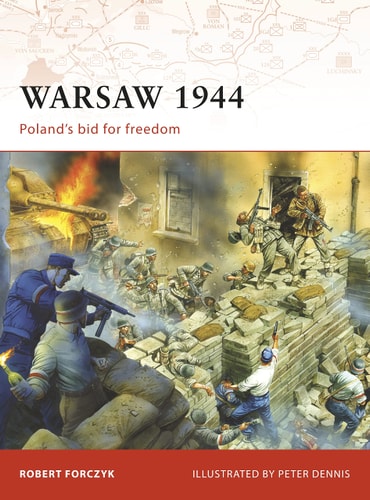
Warsaw 1944: Poland’s Bid for Freedom
0
0
As an Amazon Associate and affiliate partner, Menrva Books earns from qualifying purchases. Learn more
Author Description
Osprey's study of the involvement of Poland's Home Army in World War II (1939-1945). Poland had apparently lain dormant under the Nazi heel for nearly five years, suffering the waves of genocidal round-ups, organized looting and the brutal suppression of its culture. The Poles, however, had in fact formed an underground army, the Armia Krajowa (Home Army), and waited for the moment when German weakness would offer the opportunity for a successful rising. That moment seemed to have arrived in July 1944. As the Soviet armies began to advance into eastern Poland following the destruction of the German Army Group Centre in the successful Bagration offensive, the AK launched its revolt in Warsaw on August 1, 1944. Though its 5,000 fighters achieved some initial successes, the Germans were able to retain control over both the Vistula River bridges and the airbase, which ultimately doomed the revolt to isolation and defeat. The SS was put in charge of suppressing the rebellion, beginning another wave of atrocities, shocking even by Eastern Front standards. By the beginning of September, it was clear that the rebellion was doomed. The Western Allies attempted to fly weapons and supplies to Warsaw, but their efforts were undermined by Stalin's unwillingness to provide airbases. Stalin himself waited until the rebellion was approaching its death throes before allowing the First Polish Army (part of the Red Army) to cross the Vistula River to aid the rebellion. Although these reinforcements succeeded in briefly establishing a link-up, it was too late. The AK finally agreed to surrender on October 2.
Menrva's Summary
THE THESIS
The Warsaw Uprising of 1944 represented Poland's desperate bid for freedom against Nazi occupation. Following nearly five years of brutal suppression, Poland's underground Home Army (Armia Krajowa) launched a revolt in Warsaw on August 1, 1944, as Soviet forces advanced. Despite initial successes by the 5,000 fighters, the Germans maintained control of key bridges and the airbase, leading to the rebellion's isolation. The SS was tasked with crushing the uprising, initiating a new wave of atrocities, while Western Allied attempts to supply the rebels were hampered by Stalin's refusal to grant airbase access.
THE SCOPE MAP
- The historical context of Poland under Nazi occupation from 1939-1945.
- The formation and clandestine operations of the Armia Krajowa (Home Army).
- The strategic situation in July 1944 with the Soviet advance and the German Army Group Centre's destruction.
- The launch of the Warsaw Uprising on August 1, 1944, and its initial phases.
- The critical German control of the Vistula River bridges and airbase, leading to the revolt's isolation.
- The role of the SS in suppressing the rebellion and the ensuing atrocities.
- The limited and delayed support from the Western Allies and the Soviet Union, including Stalin's actions.
THE AUTHORITY PERSPECTIVE
This study by Robert Forczyk examines the Polish Home Army's role in World War II, focusing on the 1944 Warsaw Uprising. The book details the historical context of Poland's subjugation and the formation of the underground resistance. It analyzes the strategic decisions and military actions during the uprising, highlighting the factors that led to its ultimate defeat, such as isolation and insufficient external support. The narrative also covers the brutal suppression of the rebellion and the complex geopolitical dynamics involving the Soviet Union and Western Allies.
Page Count:
96
Publication Date:
2009-03-24
Publisher:
Bloomsbury USA
ISBN-10:
1846033527
ISBN-13:
9781846033520
Non-Fiction
History
Military History
Community Tags
Similar Books