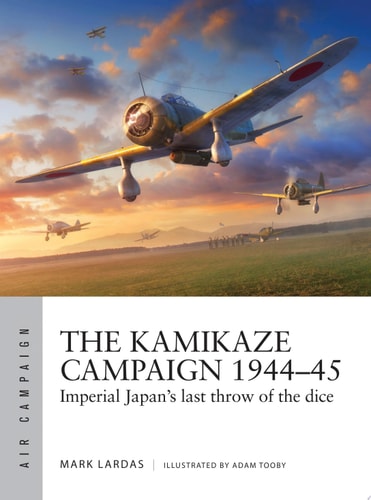
The Kamikaze Campaign 1944–45: Imperial Japan's Last Throw of the Dice
0
0
As an Amazon Associate and affiliate partner, Menrva Books earns from qualifying purchases. Learn more
Author Description
An illustrated history of how Japan devised and launched a new kind of air campaign in late 1944 – the suicidal assaults of the kamikaze units against the approaching Allied fleets. As summer changed to autumn in 1944, Japan was losing the war. Still unwilling to surrender, Japan's last hope was to try to wear down US resolve enough to reach a negotiated settlement. Extraordinary measures seemed necessary, and the most extraordinary was the formation of Special Attack Units – known to the Allies as the kamikazes. The concept of organized suicide squadrons was first raised on June 15, 1944. By August, formations were being trained. These formations were first used in the October 1944 US invasion of the Philippine Islands, where they offered some tactical success. The program was expanded into a major campaign over the rest of the Pacific War, seeing a crescendo during the struggle for Okinawa in April through May 1945. This highly illustrated history examines not just the horrific missions themselves, but the decisions behind the kamikaze campaign, how it developed, and how it became a key part of Japanese strategy. Although the attacks started on an almost ad hoc basis, the kamikaze soon became a major Japanese policy. By the end of the war, Japan was manufacturing aircraft specifically for kamikaze missions, including a rocket-powered manned missile. A plan for a massive use of kamikazes to defend the Japanese Home Islands from invasion was developed, but never executed because of Japan's surrender in August 1945. Packed with diagrams, maps and 3D reconstructions of the attacks, this book also assesses the Allied mitigation techniques and strategies and the reasons and the degree to which they were successful.
Menrva's Summary
THE THESIS
This book investigates the strategic decisions, development, and impact of Japan's Special Attack Units, known as kamikazes, during the final year of World War II. Drawing on detailed historical accounts, diagrams, maps, and 3D reconstructions, the authors examine the evolution of this suicidal air campaign from its inception in mid-1944 through its peak during the Battle of Okinawa and its planned, but unexecuted, final deployment against the Japanese Home Islands. The work analyzes the motivations behind the campaign, its tactical successes and failures, and the Allied responses to these unique aerial assaults.
THE SCOPE MAP
- The strategic context of Japan's deteriorating war situation in 1944 and the rationale for unconventional warfare.
- The conceptualization, training, and deployment of Special Attack Units.
- Detailed accounts of kamikaze missions, including diagrams and 3D reconstructions of attacks.
- Analysis of the development of specialized aircraft for kamikaze missions, including rocket-powered missiles.
- An assessment of Allied mitigation techniques and their effectiveness.
- The campaign's role in Japanese strategy, from ad hoc attacks to a major policy.
THE AUTHORITY PERSPECTIVE
This book is presented as a detailed historical account of the kamikaze campaign, focusing on the strategic and tactical aspects of Japan's final aerial offensive. The inclusion of illustrations, diagrams, maps, and 3D reconstructions suggests a visually rich and informative exploration of the subject matter, likely appealing to military history enthusiasts and those interested in the Pacific Theater of World War II. The authors' approach appears to balance the description of the missions with an analysis of the decision-making processes and Allied countermeasures, aiming for a comprehensive overview of this critical phase of the war.
Page Count:
96
Publication Date:
2022-05-26
Publisher:
Bloomsbury Publishing
ISBN-10:
1472848292
ISBN-13:
9781472848291
History
Non-Fiction
Military History
Community Tags
Similar Books