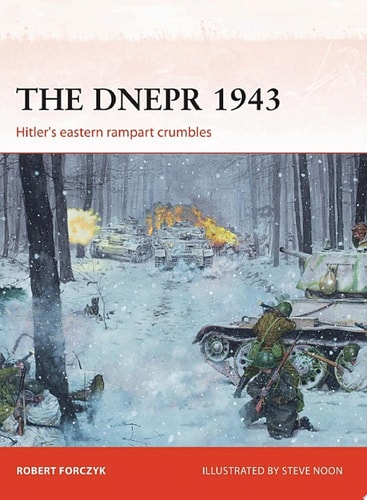
The Dnepr 1943
0
0
As an Amazon Associate and affiliate partner, Menrva Books earns from qualifying purchases. Learn more
Author Description
A highly illustrated account of the race for the River Dnepr in 1943, one of the major campaigns on the Eastern Front in World War II, written by one of the pre-eminent historians of Eastern Front military history. Against the wishes of Hitler, German forces under Erich von Manstein were forced to retreat following the failure of the Kursk offensive of July 1943. The weakened force only had one possible refuge, behind the wide Dnepr River. The race to the natural defensive line was on, with the Soviets launching one of their largest offensives of the war – with over 2 million men on the move. Robert Forczyk describes the dramatic four-month campaign that saw the Red Army not only succeed in crossing the Dnepr at multiple points, but also liberate Kiev, capital of the Ukraine. Revealing new detail about the largest Soviet airborne operation of the war and the increasingly desperate delaying tactics employed by Manstein as catastrophic casualties mounted on both sides, Forczyk charts the course of the battle that confirmed to many observers that the relentless Soviet advance westward could not be halted. Berlin would be next.
Menrva's Summary
THE THESIS
The Soviet Red Army launched a massive offensive to seize the vital Dnepr River line in 1943, forcing a German retreat after the failure at Kursk. Following Hitler's rejection of Manstein's strategic proposals, German forces were compelled to fall back to the Dnepr River, a significant natural defensive barrier. The Soviets, mobilizing over two million soldiers, initiated one of the war's largest offensives to cross this river and recapture key territories. This four-month campaign saw the Red Army achieve multiple crossings, liberate Kiev, and demonstrate the unstoppable nature of their westward advance.
THE SCOPE MAP
- Detailed account of the race for the River Dnepr in 1943, a pivotal campaign on the Eastern Front.
- Analysis of German forces under Erich von Manstein retreating after the Kursk offensive.
- Description of the Soviet offensive involving over 2 million men.
- Revelation of new details concerning the largest Soviet airborne operation of the war.
- Examination of Manstein's delaying tactics amidst mounting casualties.
- Discussion of the campaign's confirmation of the Soviet Union's relentless westward advance.
- Insights into the strategic decisions and battlefield realities faced by both German and Soviet forces.
THE AUTHORITY PERSPECTIVE
As a pre-eminent historian of Eastern Front military history, Robert Forczyk's account of the Dnepr campaign is expected to be a detailed and authoritative analysis. The book draws upon extensive research to describe the dramatic four-month struggle, revealing new details about key operations and the strategic decisions made by commanders like Manstein. The narrative focuses on the military movements, casualty figures, and the strategic implications of the Soviet advance, confirming the growing momentum of the Red Army. The work is positioned to offer a comprehensive understanding of this critical phase of World War II.
Page Count:
96
Publication Date:
2016-03-24
Publisher:
Bloomsbury UK
ISBN-10:
1472812395
ISBN-13:
9781472812391
Non-Fiction
History
Military History
Soviet Union
Germany
Campaigns
Eastern Front
Community Tags
Similar Books