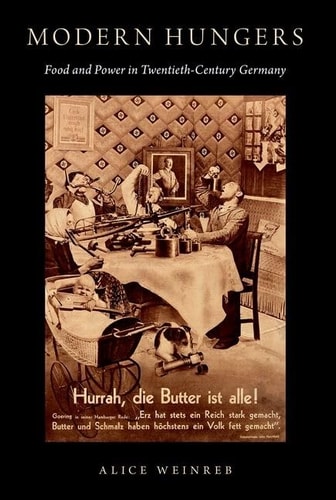
Modern Hungers: Food and Power in Twentieth-Century Germany
0
0
As an Amazon Associate and affiliate partner, Menrva Books earns from qualifying purchases. Learn more
Author Description
During World War I and II, modern states for the first time experimented with feeding--and starving--entire populations. Within the new globalizing economy, food became intimately intertwined with waging war, and starvation claimed more lives than any other weapon. As Alice Weinreb shows in Modern Hungers, nowhere was this new reality more significant than in Germany, which struggled through food blockades, agricultural crises, economic depressions, and wartime destruction and occupation at the same time that it asserted itself as a military, cultural, and economic powerhouse of Europe.The end of armed conflict in 1945 did not mean the end of these military strategies involving food. Fears of hunger and fantasies of abundance were instead reframed within a new Cold War world. During the postwar decades, Europeans lived longer, possessed more goods, and were healthier than ever before. This shift was signaled most clearly by the disappearance of famine from the continent. So powerful was the experience of post-1945 abundance that it is hard today to imagine a time when the specter of hunger haunted Europe, demographers feared that malnutrition would mean the end of whole nations, and the primary targets for American food aid were Belgium and Germany rather than Africa. Yet under both capitalism and communism, economic growth as well as social and political priorities proved inseparable from the modern food system.Drawing on sources ranging from military records to cookbooks to economic and nutritional studies from a multitude of archives, Modern Hungers reveals similarities and striking ruptures in popular experience and state policy relating to the industrial food economy. In so doing, it offers historical perspective on contemporary concerns ranging from humanitarian food aid to the gender-wage gap to the obesity epidemic.
Menrva's Summary
THE THESIS
This book investigates how the modern German state utilized food as a primary instrument of power, warfare, and social control throughout the twentieth century. Alice Autumn Weinreb, a historian specializing in modern European history, analyzes the intersection of state policy, nutritional science, and economic strategy. By examining the transition from wartime starvation tactics to the postwar era of abundance, she argues that the modern food system was foundational to the development of both capitalist and communist political structures in Germany.
THE SCOPE MAP
What You Will Find
- Analysis of food blockades and agricultural crises during the World Wars.
- Examination of the shift from famine-era policies to Cold War consumerism.
- Comparative study of food systems under capitalist and communist regimes.
- Integration of diverse primary sources including military records, cookbooks, and nutritional studies.
Scope Limits
- The analysis is geographically centered on Germany and does not provide a comprehensive global history of food policy.
- The text focuses primarily on state-level policy and institutional strategy rather than individual culinary history.
THE AUTHORITY PERSPECTIVE
Scholars and historians recognize this work as a significant contribution to the field of food studies and twentieth-century European political history. Readers frequently note the academic density of the prose and the author's meticulous use of archival evidence to connect historical hunger to contemporary socioeconomic issues.
Page Count:
330
Publication Date:
2019-10-15
Publisher:
Oxford University Press
ISBN-10:
0190092483
ISBN-13:
9780190092481
History
Politics
New Used & Rental Textbooks
Germany
Food Industry
Food Studies
Europe
Power Social sciences
Hunger
Military History
Food supply
Public Policy
World politics
Politics & Government
Food Science
German history
Germany economic conditions
European History
Community Tags
Similar Books