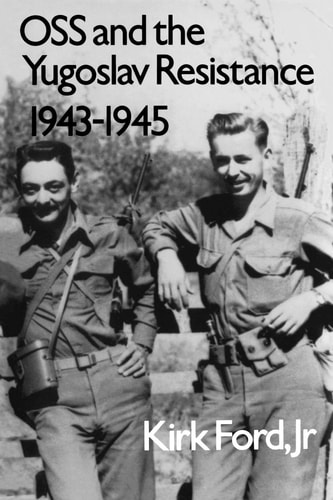
OSS and the Yugoslav Resistance, 1943-1945
0
0
As an Amazon Associate and affiliate partner, Menrva Books earns from qualifying purchases. Learn more
Author Description
During the Second World War few countries provided a more difficult challenge for Gen. "Wild Bill" Donovan's Office of Strategic Services than did Yugoslavia. Working with its British counterpart, OSS sought to sustain the Yugoslav resistance in its struggle against the Axis occupiers. Unfortunately, OSS personnel, who first began entering the country in the late summer of 1943, found themselves caught up in a ruthless civil war between Draza Mihailovich's Nationalists or Chetniks and Josip-Broz Tito's Partisans. OSS enjoyed some notable successes, ferrying badly needed supplies to Tito in the fall of 1943, assisiting in the evacuation of hundreds of Allied airmen, and collecting valuable military and political intelligence. On the other hand, President Roosevelt's decision to allow Prime Minister Churchill to play the Allied hand in the Balkans meant that the agency would have almost no influence on Allied policy. Kirk Ford, Jr., has mined the recently declassified operational records of the OSS and conducted interviews or correspondence with more than sixty of the surviving participants of the events in Yugoslavia. His findings challenge the view of Mihailovich as collaborator and Tito as liberator while shedding new light on both the motives behind Allied policy decisions and the extent to which these decisions affected the internal balance of power in Yugoslavia. By telling the story of the dangers OSS operatives faced behind enemy lines and by tracing the relationship between the OSS and British intelligence, Ford reveals that intrigue, deception, and secrecy were not activities reserved exclusively for the enemy.
Menrva's Summary
THE THESIS
The Office of Strategic Services faced a complex and dangerous challenge in Yugoslavia during World War II, navigating a brutal civil war between Nationalist Chetniks and Communist Partisans while attempting to support the Yugoslav resistance against Axis occupiers. The OSS, entering the country in late 1943, sought to provide crucial supplies and intelligence, notably ferrying aid to Tito's Partisans and assisting in the evacuation of Allied airmen. However, the agency's influence on Allied policy was minimal due to President Roosevelt's decision to cede Balkan strategy to Prime Minister Churchill. Kirk Ford Jr.'s research, drawing on declassified OSS records and interviews with participants, aims to re-evaluate the roles of Draza Mihailovich and Josip Broz Tito, and to illuminate the impact of Allied decisions on Yugoslavia's internal power dynamics.
THE SCOPE MAP
- Analysis of the Office of Strategic Services' operations in Yugoslavia between 1943 and 1945.
- Examination of the complex relationship between the OSS, British intelligence, and the Yugoslav resistance movements (Chetniks and Partisans).
- Exploration of the internal civil war within Yugoslavia and its impact on Allied strategy.
- Details on OSS successes, including supply drops, airman rescues, and intelligence gathering.
- Discussion of the limitations imposed by Allied policy decisions, particularly those influenced by Churchill.
- Re-evaluation of the historical perceptions of Draza Mihailovich and Josip Broz Tito.
- Insights into the motives behind Allied policy and its consequences for the balance of power in Yugoslavia.
THE AUTHORITY PERSPECTIVE
This book is regarded as a significant contribution to the understanding of World War II intelligence operations in the Balkans. The author's reliance on declassified OSS records and firsthand accounts provides a detailed and nuanced perspective on the challenges faced by operatives. It offers a critical re-examination of key figures and events, potentially shifting established historical narratives regarding the Yugoslav resistance and Allied involvement. The work is noted for its exploration of the intricate web of intrigue, deception, and secrecy that characterized the era.
Page Count:
249
Publication Date:
1992-01-01
Publisher:
Texas A & M University Press
ISBN-10:
158544040X
ISBN-13:
9781585440405
Non-Fiction
History
Espionage
Balkan History
Military History
Community Tags
Similar Books