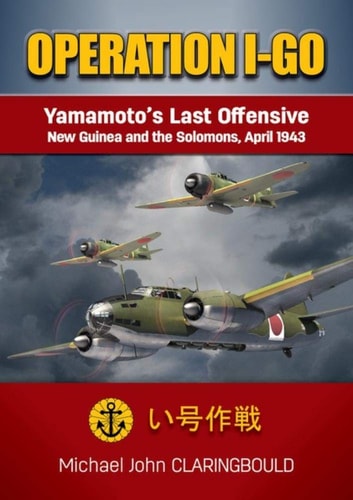
Operation I-Go: Yamamoto's Last Offensive - New Guinea and the Solomons April 1943
0
0
As an Amazon Associate and affiliate partner, Menrva Books earns from qualifying purchases. Learn more
Author Description
In early 1943 Japanese forces in the South Pacific had suffered three key strategic setbacks at Guadalcanal, Kokoda and the Battle of the Bismarck Sea. However Japanese strength in the theater was far from spent, and the commander of the IJN Combined Fleet Admiral Yamamoto sensed an opportunity. By temporarily bolstering his air force at Rabaul with carrier-based airpower, Yamamoto assembled a strike force of hundreds of aircraft. With these he planned to overwhelm Allied defenses in a multi-day blitz against four crucial locations. Named Operation I-Go, it would be the largest IJN air operation ever launched in the region. The odds favored the plan, but by 1943 I-Go was a huge gamble. Would it strike a body blow and give the Allies reason to pause their advance? Or would it cause irrecoverable wastage of IJN offensive air power? The results of I-Go were surprising, although it only achieved a fraction of what the Japanese claimed. The greatest irony was that it led to the death of its architect, Yamamoto. This is the first detailed account of I-Go written with reference to both Japanese and Allied sources, and it surely sets a new historical benchmark for this key chapter of the Pacific War.
Menrva's Summary
THE THESIS
Operation I-Go represented a desperate gamble by Admiral Yamamoto to reverse the tide of the Pacific War in early 1943. Facing mounting Allied pressure after significant Japanese setbacks, Yamamoto amassed a formidable air strike force at Rabaul, intending to overwhelm Allied defenses through a multi-day aerial assault on four key locations. This ambitious plan, the largest IJN air operation ever launched in the region, carried immense risk: success could have halted the Allied advance, while failure threatened to deplete Japan's offensive air power irrevocably. The operation's surprising outcome, which achieved only a fraction of its stated goals, ultimately led to the death of its architect, Yamamoto, and marked a critical turning point in the Pacific War.
THE SCOPE MAP
- Detailed account of Operation I-Go, the largest IJN air operation in the region.
- Analysis of Japanese strategic setbacks in early 1943 at Guadalcanal, Kokoda, and the Battle of the Bismarck Sea.
- Examination of Admiral Yamamoto's decision to bolster air power at Rabaul with carrier-based aircraft.
- Description of the multi-day air blitz targeting four crucial Allied locations.
- Assessment of the risks and potential outcomes of Operation I-Go.
- Evaluation of the operation's surprising results and its limited success.
- Exploration of the irony that Operation I-Go led to Yamamoto's death.
- Utilizes both Japanese and Allied sources for a comprehensive historical perspective.
THE AUTHORITY PERSPECTIVE
This detailed account of Operation I-Go is presented as a new historical benchmark for this chapter of the Pacific War, drawing on both Japanese and Allied sources. The narrative explores the strategic context of early 1943, highlighting Japanese setbacks and Yamamoto's ambitious plan to regain initiative. The book examines the surprising results of the operation, noting its limited success and the tragic irony of its architect's demise. It aims to provide a comprehensive and authoritative perspective on a pivotal moment in the Pacific conflict.
Page Count:
158
Publication Date:
2020-01-01
Publisher:
Avonmore Books
ISBN-10:
0648665941
ISBN-13:
9780648665946
Non-Fiction
History
Naval history
Military History
Pacific Theater
Community Tags
Similar Books