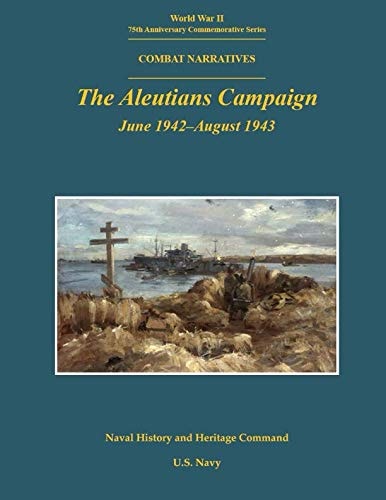
Combat Narratives: The Aleutians Campaign: June 1942–August 1943
0
0
As an Amazon Associate and affiliate partner, Menrva Books earns from qualifying purchases. Learn more
Author Description
Until the end of the Pacific War no one can make a conclusive statement of the objectives of the Japanese attack on the Aleutian Islands in June 1942. The enemy may have been planning the subsequent conquest of all the islands in order to obtain access to Canada and our northwestern states. He may even have aimed at an immediate invasion of Alaska, only to be deterred by our victory at Midway. It is well known that the Japanese had long coveted Alaska and the Aleutians, and that many of their military leaders considered these poorly defended outposts the logical route for an invasion of North America.The enemy’s intentions may have been less ambitious, however. He may merely have planned to protect his northern flank, to divide our forces, and to complicate our defense of Hawaii and the West Coast after the expected capture of Midway.Whatever his primary motives, the crushing blow administered by our forces in the mid-Pacific drastically revised the strategic situation. The reasons why Japan clung thereafter to her footholds in the western Aleutians are obscure. But it is probable that Attu and Kiska were either to provide jumping-off places for a future invasion, or to constitute advanced observation posts and defenses for the Empire. Perhaps both ends were envisaged. At all events, it was immediately clear that the occupation provided a continuing threat to our security. Even if this threat did not develop, any plans for seizing the offensive in the Central Pacific would be difficult to execute while the enemy maintained his flanking positions in the north. Furthermore, considering the war as a whole, every day that hostile troops remained on American soil was as beneficial to Japanese morale as it was deleterious to that of our own people.The situation was grave. Because of our commitments elsewhere, the means of quickly resolving it were far from adequate. As a result, the Japanese were ejected from the Aleutians only after 15 months of arduous operations which
Menrva's Summary
THE THESIS
The Aleutian Islands Campaign presented a complex strategic challenge for both the United States and Japan during World War II. The initial Japanese objectives in attacking the Aleutians in June 1942 remain debated, with possibilities ranging from an invasion of North America to a strategic move to protect their northern flank and divide Allied forces. Following the decisive Allied victory at Midway, Japan's continued occupation of Attu and Kiska became a persistent threat to American security and complicated offensive operations in the Pacific. The arduous 15-month campaign to dislodge Japanese forces from American soil was a testament to the strategic difficulties and the commitment required to resolve the situation.
THE SCOPE MAP
- Analysis of the strategic objectives behind Japan's June 1942 attack on the Aleutian Islands.
- Exploration of potential Japanese aims, including invasion of Canada and the US, or protection of their northern flank.
- Discussion of how the Battle of Midway altered the strategic landscape and influenced Japanese intentions in the Aleutians.
- Examination of the reasons for Japan's continued occupation of Attu and Kiska after Midway.
- Assessment of the threat posed by Japanese presence on American soil to US security and Pacific operations.
- Details on the 15-month arduous campaign undertaken by Allied forces to reclaim the Aleutian Islands.
- Consideration of the impact of the campaign on Allied morale and strategic planning.
THE AUTHORITY PERSPECTIVE
This historical account, drawing from the Naval History and Heritage Command, meticulously details the strategic complexities and operational challenges of the Aleutian Islands Campaign. It probes the ambiguous motivations behind Japan's initial actions and their subsequent retention of key islands, framing them within the broader context of the Pacific War. The narrative emphasizes the significant commitment of resources and time required to dislodge enemy forces from American soil, highlighting the campaign's impact on Allied strategic flexibility and morale.
Page Count:
114
Publication Date:
2019-05-14
Publisher:
Independently published
ISBN-10:
1098729374
ISBN-13:
9781098729370
Non-Fiction
History
Military History
Community Tags
Similar Books