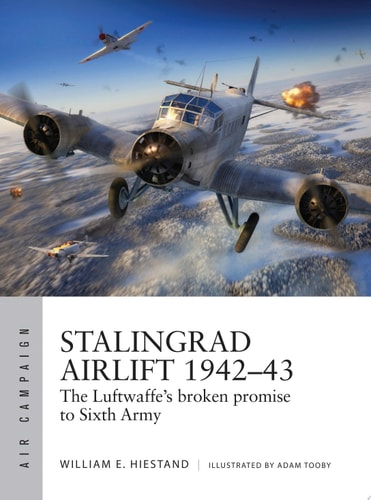
Stalingrad Airlift 1942–43
0
0
As an Amazon Associate and affiliate partner, Menrva Books earns from qualifying purchases. Learn more
Author Description
The story of what really led to Germany losing the battle of Stalingrad - the inability of the Luftwaffe to keep Sixth Army supplied throughout the winter of 1942–43 - and why this crucial airlift failed. Luftwaffe chief Hermann Goering's failure to deliver his promise to keep Sixth Army supplied at Stalingrad was one of the most hard-hitting strategic air failures of World War II. 300 tons a day of supplies were required to sustain the Sixth Army, flown in against a Soviet fighter force whose capabilities were rapidly being transformed. The Luftwaffe's failure left Sixth Army trapped, vulnerable and too weak to attempt a breakout. The destruction of Sixth Army was one of the major turning points in World War II but the Luftwaffe's crucial role in this disaster has often been overlooked. Some claim the attempt was doomed from the beginning but, in this intriguing book, author William E. Hiestand explains how the Germans had amassed sufficient aircraft to, at least theoretically, provide the supplies needed. Demands of aircraft maintenance, awful weather and, in particular, the Soviet air blockade crippled the airlift operation. In addition, the employment of increasing numbers of modern aircraft by the Soviet Air Force using more flexible tactics, coupled with Chief Marshal Novikov's superior Air Army organisation proved decisive. The Luftwaffe did eventually recover and mounted focused operations for control of limited areas of the Eastern Front, but overall it had lost its dominance. Packed with strategic diagrams and maps, archive photos and artwork of aerial battles over Stalingrad, and including bird's eye views of Operation Winter Storm and airlift operations and tactics, this title clearly demonstrates how the Luftwaffe lost its strategic initiative in the air.
Menrva's Summary
THE THESIS
The Stalingrad airlift of 1942-43 represents a critical failure in World War II logistics and air power. This book examines the strategic air failure of the Luftwaffe to supply the German Sixth Army, a task requiring 300 tons of supplies daily against a rapidly evolving Soviet fighter force. Author William E. Hiestand argues that while theoretically possible with the available aircraft, the airlift was crippled by maintenance demands, adverse weather, and the decisive impact of Soviet Air Force advancements in organization, tactics, and modern aircraft. The failure left the Sixth Army trapped and contributed significantly to its destruction, a major turning point in the war that has often overlooked the Luftwaffe's pivotal role.
THE SCOPE MAP
- What led to Germany's loss at Stalingrad, focusing on the Luftwaffe's supply mission.
- Analysis of Hermann Goering's failed promise to sustain the Sixth Army.
- The required daily supply tonnage versus the capabilities of the Soviet air force.
- Examination of aircraft maintenance, weather, and the Soviet air blockade as crippling factors.
- The impact of modern Soviet aircraft and superior Air Army organization.
- Strategic diagrams and maps illustrating aerial battles and airlift tactics.
- Archive photos and artwork depicting the conflict over Stalingrad.
- An assessment of how the Luftwaffe lost its strategic initiative on the Eastern Front.
THE AUTHORITY PERSPECTIVE
This book delves into the critical failure of the Luftwaffe's airlift to supply the German Sixth Army during the Battle of Stalingrad, a pivotal event in World War II. It posits that the failure was not solely due to insurmountable odds but also to specific operational challenges, including aircraft maintenance, weather, and the evolving capabilities of the Soviet Air Force. The analysis is supported by strategic diagrams, maps, and archival imagery, aiming to demonstrate how this logistical and aerial misstep led to the loss of German air superiority on the Eastern Front.
Page Count:
96
Publication Date:
2023-01-19
Publisher:
Bloomsbury UK
ISBN-10:
1472854322
ISBN-13:
9781472854322
Non-Fiction
History
Military History
Community Tags
Similar Books