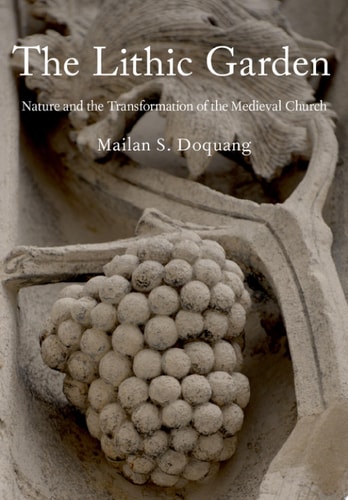
The Lithic Garden: Nature and the Transformation of the Medieval Church
0
0
As an Amazon Associate and affiliate partner, Menrva Books earns from qualifying purchases. Learn more
Author Description
The Lithic Garden offers innovative perspectives on the role of ornament in medieval church design. Focusing on the foliate friezes articulating iconic French monuments such as Amiens Cathedral, it demonstrates that church builders strategically used organic motifs to integrate the interior and exterior of their structures, thus reinforcing the connections and distinctions between the entirety of the sacred edifice and the profane world beyond its boundaries. With this exquisitely illustrated monograph, Mailan S. Doquang argues that, contrary to widespread belief, monumental flora was not just an extravagant embellishment or secondary byproduct, but a semantically-charged, critical design component that inflected the stratified spaces of churches in myriad ways. By situating the proliferation of foliate friezes within the context of the Crusades, The Lithic Garden provides insights into the networks of exchange between France, Byzantium, and the Levant, contributing to the "global turn" in art and architectural History.
Menrva's Summary
THE THESIS
This work investigates the functional and symbolic role of foliate ornamentation in medieval French church architecture, challenging the perception of such motifs as mere decoration. Mailan S. Doquang, an expert in medieval art and architecture, utilizes a rigorous analysis of iconic monuments like Amiens Cathedral to argue that organic motifs served as critical design elements. By examining the placement and proliferation of these carvings, the author demonstrates how they mediated the boundary between sacred interior spaces and the profane exterior world. The study further contextualizes these architectural choices within the broader geopolitical landscape of the Crusades and cross-cultural exchanges.
THE SCOPE MAP
What You Will Find
- Analysis of foliate friezes in major French Gothic cathedrals
- Examination of the architectural integration of interior and exterior spaces
- Historical context linking architectural motifs to the Crusades and Mediterranean trade networks
- Comparative study of artistic exchange between France, Byzantium, and the Levant
Scope Limits
- Does not provide a comprehensive survey of all medieval European church ornamentation
- Focuses primarily on French monuments rather than broader continental variations
THE AUTHORITY PERSPECTIVE
Scholars and art historians recognize this text as a significant contribution to the study of Gothic architectural semantics and the global interconnectedness of medieval art. Readers frequently note the academic density of the prose and the depth of the visual analysis provided in the monograph.
Page Count:
269
Publication Date:
2018-01-01
Publisher:
Oxford University Press
ISBN-10:
0190631813
ISBN-13:
9780190631819
History
Religion
Humanities
Art History
Architectural History
French History
Medieval Art
Religious architecture
European History
Community Tags
Similar Books