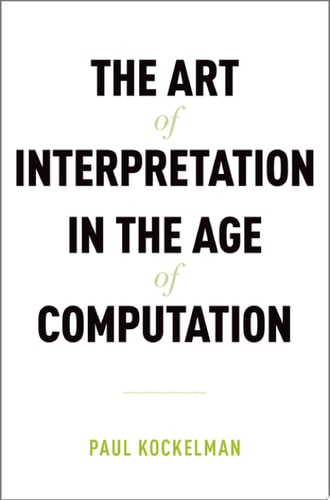
The Art of Interpretation in the Age of Computation
0
0
As an Amazon Associate and affiliate partner, Menrva Books earns from qualifying purchases. Learn more
Author Description
This book is about media, mediation, and meaning. The Art of Interpretation focuses on a set of interrelated processes whereby ostensibly human-specific modes of meaning become automated by machines, formatted by protocols, and networked by infrastructures. That is, as computation replaces interpretation, information effaces meaning, and infrastructure displaces interaction. Or so it seems. Paul Kockelman asks: What does it take to automate, format, and network meaningful practices? What difference does this make for those who engage in such practices? And what is at stake? Reciprocally: How can we better understand computational processes from the standpoint of meaningful practices? How can we leverage such processes to better understand such practices? And what lies in wait? In answering these questions, Kockelman stays very close to fundamental concerns of computer science that emerged in the first half of the twentieth-century. Rather than foreground the latest application, technology or interface, he accounts for processes that underlie each and every digital technology deployed today. In a novel method, The Art of Interpretation leverages key ideas of American pragmatism-a philosophical stance that understands the world, and our relation to it, in a way that avoids many of the conundrums and criticisms of conventional twentieth-century social theory. It puts this stance in dialogue with certain currents, and key texts, in anthropology and linguistics, science and technology studies, critical theory, computer science, and media studies.
Menrva's Summary
THE THESIS
This book investigates the shifting relationship between human interpretation and computational automation, questioning how meaning is transformed when mediated by digital infrastructures. Paul Kockelman, an anthropologist and scholar of media, utilizes a framework rooted in American pragmatism to analyze the underlying processes of digital technology. By bridging the gap between computer science and social theory, he examines the implications of replacing human interaction with automated protocols and networked systems.
THE SCOPE MAP
What You Will Find
- Analysis of media, mediation, and meaning within digital environments
- Application of American pragmatism to contemporary technological concerns
- Interdisciplinary synthesis of anthropology, linguistics, and computer science
- Examination of foundational computational processes rather than specific interfaces
Scope Limits
- Does not focus on the latest consumer applications or specific software interfaces
- Does not provide a technical manual for programming or software development
THE AUTHORITY PERSPECTIVE
Scholars in media studies and anthropology recognize this work as a rigorous theoretical inquiry into the nature of digital mediation. Readers frequently note the academic density of the prose, which requires familiarity with pragmatist philosophy and social theory to fully grasp the author's arguments.
Page Count:
245
Publication Date:
2017-01-01
Publisher:
Oxford University Press
ISBN-10:
0190636556
ISBN-13:
9780190636555
Philosophy
Critical Theory
English & College Success
Technology Studies
Ontology
Computer Science
Media Studies
English
Semiotics
Anthropology
Linguistics
Anthropological linguistics