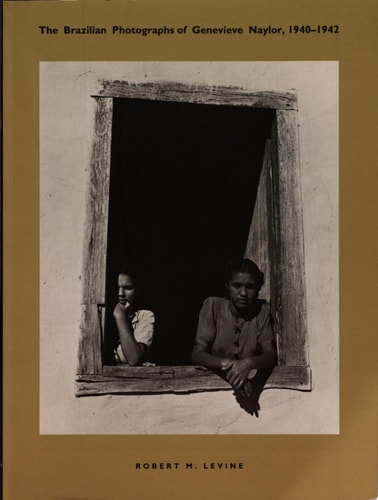
The Brazilian Photographs of Genevieve Naylor, 1940-1942
0
0
As an Amazon Associate and affiliate partner, Menrva Books earns from qualifying purchases. Learn more
Author Description
In the early 1940s as the conflict between the Axis and the Allies spread worldwide, the U.S. State Department turned its attention to Axis influence in Latin America. As head of the Office of Inter-American Affairs, Nelson Rockefeller was charged with cultivating the region's support for the Allies while portraying Brazil and its neighbors as dependable wartime partners. Genevieve Naylor, a photojournalist previously employed by the Associated Press and the WPA, was sent to Brazil in 1940 by Rockefeller's agency to provide photographs that would support its need for propaganda. Often balking at her mundane assignments, an independent-minded Naylor produced something far different and far more rich--a stunning collection of over a thousand photographs that document a rarely seen period in Brazilian history. Accompanied by analysis from Robert M. Levine, this selection of Naylor's photographs offers a unique view of everyday life during one of modern Brazil's least-examined decades. Working under the constraints of the Vargas dictatorship, the instructions of her employers, and a chronic shortage of film and photographic equipment, Naylor took advantage of the freedom granted her as an employee of the U.S. government. Traveling beyond the fashionable neighborhoods of Rio de Janeiro, she conveys in her work the excitement of an outside observer for whom all is fresh and new--along with a sensibility schooled in depression-era documentary photography of Dorothea Lange and Walker Evans, as well as the work of Cartier-Bresson and filmmaker Serge Eisenstein. Her subjects include the very rich and the very poor, black Carnival dancers, fishermen, rural peasants from the interior, workers crammed into trolleys--ordinary Brazilians in their own setting--rather than simply Brazilian symbols of progress as required by the dictatorship or a population viewed as exotic Latins for the consumption of North American travelers. With Levine's text providing details of Naylor'
Menrva's Summary
THE THESIS
The U.S. State Department sought to shape international perception of Brazil during a critical wartime period, but photographer Genevieve Naylor captured a far richer reality. Sent to Brazil in 1940 by Nelson Rockefeller's Office of Inter-American Affairs, Naylor was tasked with producing propaganda photographs. However, her independent spirit and documentary sensibility led her to create over a thousand images that reveal the complexities of everyday Brazilian life under the Vargas dictatorship, often defying her employers' directives. Her work documents a rarely seen period, offering a nuanced view of the nation beyond official narratives.
THE SCOPE MAP
- A curated selection of over a thousand photographs taken by Genevieve Naylor in Brazil between 1940 and 1942.
- Analysis and contextualization of Naylor's work by historian Robert M. Levine.
- Depictions of diverse Brazilian society, including the wealthy and the poor, Carnival dancers, fishermen, rural peasants, and urban workers.
- Insights into the socio-political climate of Brazil during the Vargas dictatorship and World War II.
- Exploration of Naylor's photographic style, influenced by depression-era documentary photography and European modernists.
- Details on the constraints Naylor worked under, including employer instructions and limited resources.
THE AUTHORITY PERSPECTIVE
This collection is recognized for its significant contribution to understanding Brazilian history and photography. The juxtaposition of Naylor's artistic vision with her official propaganda assignment offers a unique perspective on the era. Critics and historians have noted the depth and breadth of her documentation, highlighting her ability to capture the essence of everyday life across social strata. The accompanying text by Robert M. Levine further enriches the reader's understanding of the historical context and Naylor's artistic achievements.
Page Count:
155
Publication Date:
1998-01-01
Publisher:
Duke University Press
ISBN-10:
0822321890
ISBN-13:
9780822321897
Photography
Non-Fiction
History
Social History
Documentary photography
Community Tags
Similar Books















Reader Comments
Share Your Thoughts
No comments yet. Be the first to share your thoughts!